

















What Is Epoxy Resin?
A Beginner's Guide to Epoxy Basics
April 2026
You've seen it on a stunning river table, a glass-smooth bar top, or a woodworking project that looked too perfect to be real. Maybe you've watched a pour video and thought: I want to make that. But before you crack open a kit, it helps to understand what epoxy resin actually is — how it works, what forms it comes in, and what it can do. This guide covers the basics, so you can start your first project with confidence.

So, What Is Epoxy Resin?
Epoxy resin is a two-part system made up of a resin and a hardener. On their own, each component is a stable liquid. But when you combine them in the right ratio and mix them thoroughly, they undergo a chemical reaction that transforms the liquid mixture into a hard, durable solid.
That reaction is exothermic, meaning it generates heat as it cures. The heat is part of what drives the transformation — and it's also why you'll hear warnings about pouring too thick too fast. More on that later.
Once fully cured, epoxy is rigid, strong, and resistant to water, chemicals, and everyday wear. Depending on the formula, it can cure to a crystal-clear finish or be tinted with pigments, mica powders, and alcohol inks for color effects. It bonds to a wide range of surfaces, including wood, metal, fiberglass, concrete, ceramics, and glass.
You'll often see "epoxy" and "epoxy resin" used interchangeably — they mean the same thing. Throughout this guide and across TotalBoat's product line, we use both.
Types of Epoxy Resin
Not all epoxies are built the same. Different formulas are engineered for different jobs — and one of the biggest differences between them is viscosity, or how thick and how freely the liquid flows.
Think of it this way: penetrating epoxy flows like water, thin and fast-moving, designed to soak into surfaces. Coating epoxy pours more like syrup, flowing smoothly but staying put where you need it. Deep pour epoxy falls somewhere in between. Understanding viscosity helps you understand why different epoxies behave differently — and why using the right formula for your project matters.
Here's a breakdown of the main types you'll encounter:
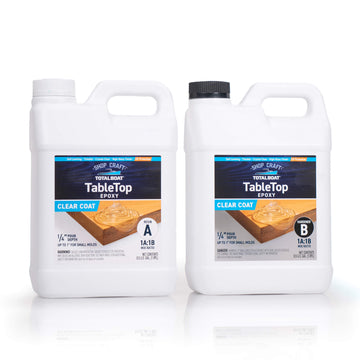
Coating Epoxy (Table Top Epoxy)
Coating epoxy is a higher-viscosity formula designed to be applied in thin, self-leveling layers over a surface. It flows smoothly, self-levels on its own, and cures to a hard, high-gloss finish. This is the go-to choice for furniture, countertops, bar tops, and live-edge slabs — anywhere you want that glass-like surface coat.
Because it's formulated for thin coats (typically ⅛" to ¼" per layer), coating epoxy generates and dissipates heat efficiently at that thickness. Pouring it deeper than recommended can cause overheating, yellowing, or cracking.
Deep Pour / Casting Epoxy
Deep pour epoxy is a lower-viscosity formula engineered specifically for thicker single pours — often up to 2–3 inches at a time, depending on the product. Its slower cure cycle and lower heat output per layer allow larger volumes to cure without overheating.
This is the formula used for river tables, embedded objects, molds, and casting projects where you need significant depth in one pour. It's not designed to coat surfaces the way a table top epoxy would, but it excels at filling voids and building mass.
Penetrating Epoxy
Penetrating epoxy has very low viscosity by design — it's meant to flow like water so it can soak deep into porous, soft, or degraded wood rather than sitting on top of it. Where a coating epoxy would create a film over the surface, penetrating epoxy works its way into the wood fibers, consolidating and stabilizing the material from the inside out.
It's the first step in rot repair and wood restoration, and it's commonly used to seal bare, porous wood before a flood coat or casting pour to prevent air bubbles from working their way up through the surface.
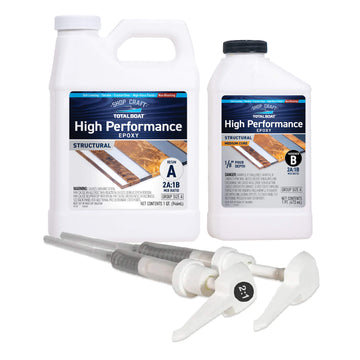
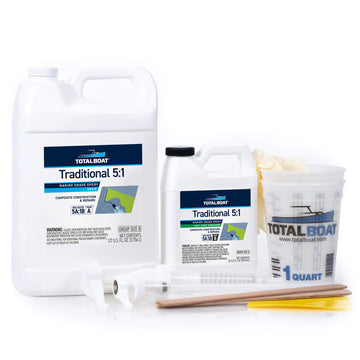
Marine / Structural Epoxy
Marine and structural epoxies are formulated for strength, durability, and resistance to the stresses of real-world use such as moisture, impact, flexing, and bonding under heavy loads. They sit in the medium viscosity range, which makes them versatile: suitable for coating, bonding, laminating fiberglass, and filling when combined with thickening additives like colloidal silica or milled glass fiber.
These systems are commonly used in boat building and repair, but they're equally at home in structural woodworking, composite fabrication, and any application where mechanical strength matters as much as aesthetics.
Pro Tip: Some marine epoxy resins can “blush”, creating a waxy film while curing. Remove with a scrub pad using soap and water, or avoid altogether with a crystal-clear, non-blushing formula like High Performance.
Epoxy Putty
Epoxy putty takes the same core two-part chemistry — resin and hardener — and delivers it in a thick, workable paste rather than a pourable liquid. Products like Fixwood and TotalFair are pre-formulated for specific repair jobs: Fixwood is a wood-toned, sandable putty designed to rebuild and restore rotted or damaged wood, while TotalFair is a lightweight fairing compound used to smooth and fair hull surfaces before painting. Both mix by hand or with a tool to a consistent, non-sagging consistency that holds its shape while you work and cures hard enough to be shaped, drilled, or painted. Because there's no measuring or mixing cups involved, epoxy putties are one of the most accessible and forgiving ways to work with epoxy chemistry.
Art & Craft Epoxy
Art resins are optimized for clarity, color, and ease of use at smaller scales. They're typically formulated with a simple 1:1 mix ratio (equal parts resin and hardener by volume) to make measuring straightforward, and they cure exceptionally clear, making them ideal for showcasing pigments, embedded materials, and fine detail work. Viscosity ranges depending on the formula - use lower viscosity for casting molds and higher viscosity for creating ocean waves and other artistic effects.
You'll find art epoxy used for jewelry, coasters, trays, decorative panels, and mixed-media artwork. The smaller batch sizes and user-friendly ratios make this a natural starting point for beginners

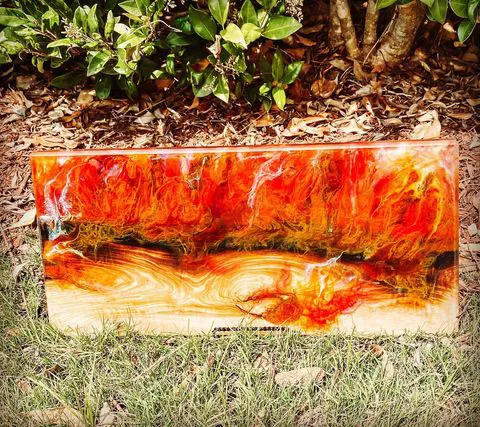
Epoxy wave art by Grace Bell Art using TotalBoat Wave and Marble Epoxy.
What Is Epoxy Used For?
Epoxy is one of the most versatile materials in a maker's toolkit. Here's a look at the most common applications, organized by project type:
Furniture, bar tops & countertops
Coating epoxy creates a smooth, durable, high-gloss finish that enhances wood grain and protects surfaces from scratches, spills, and heat. It's widely used on dining tables, kitchen counters, restaurant bar tops, and live-edge slabs.
River tables & casting
Deep pour epoxy is the workhorse of river table builds and casting projects. Whether you're filling the channel between two wood slabs, embedding objects in a clear block, or pouring into a silicone mold, deep pour formulas are designed to handle the depth and volume these projects require.
Wood sealing & rot repair
Penetrating epoxy is the starting point for rot repair and wood restoration. It soaks into compromised wood to stop decay and stabilize the material before rebuilding the surface with a filler or applying a finish coat. It's also used as a seal coat on bare, porous wood before a flood coat to minimize bubbles. Once the penetrating epoxy has cured, an epoxy putty can be used to rebuild lost material — filling voids, reshaping damaged sections, and restoring the wood to a workable surface that can be sanded, shaped, and refinished.
Boat building & repair
Structural and marine epoxies are used throughout the boatbuilding process such as laminating fiberglass, creating high-strength bonds, fairing hull surfaces, and sealing wood against moisture. Their balance of strength, flexibility, and resistance to moisture, corrosion, and chemicals makes them the standard in marine repair and restoration.
Art, jewelry & crafts
Art resins bring epoxy's clarity and durability to smaller creative projects. Jewelry, coasters, trays, resin keychains, and home decor, are all common applications involving silicone molds. The ability to add vivid color with mica powders, alcohol inks, and pigment dispersions makes art epoxy a popular medium for makers and artists alike. Some artists use epoxy to create free-from patterns or effects, including ocean waves, geodes, and blooms.
Bonding & adhesion
Epoxy is one of the strongest adhesives available, and bonding is one of its most practical everyday uses. When you need to join two surfaces like wood to wood, wood to fiberglass, or metal to concrete, epoxy creates a waterproof, structural bond that outlasts most other options. Thickened epoxy adhesives, like those that come pre-mixed in cartridge form, dispense through a static mixing tip much like a caulk gun, making it easy to apply a precise, non-sagging bead exactly where you need it. No mixing cups, no measuring — just squeeze and go. It's epoxy in its most hands-on, immediate form.

Fiberglassing with TotalBoat High Performance Epoxy
What to Know Before You Start
Epoxy can be a beginner-friendly material, but it does have rules. The most important ones to know before your first pour: know the mix ratio, work in the right condition, and keep the working time in mind.
Every epoxy formula has a specific ratio of resin to hardener — whether that's 1:1, 2:1, or something else entirely — and that ratio must be followed precisely. Getting it wrong is the most common reason epoxy doesn't cure properly.
Temperature and humidity matters too: most formulas work best between 70°F and 80°F in lower humidity. Too cold and the epoxy thickens, traps bubbles, and slows the cure dramatically. Too hot and it may set faster than you can work with it. And too much moisture in the air can cause cloudiness and tacky spots.
Once you mix resin and hardener together, the clock starts. You have a limited window, called the working time or pot life, before the epoxy begins to thicken and gel. After that point, it can no longer be poured, spread, or self-leveled.
The good news: none of this is complicated once you know what to expect. For a full walkthrough of how to measure, mix, and pour epoxy from start to finish, head over to our Epoxy Resin Mixing & Pouring 101 guide.