

















Bubbles, bubbles, toil and trouble is what you get when you pour epoxy too deep. It’ll bubble, smoke, shrink, crack, and you’ll have to start over. Hey – we’ve all been there – pushed the pour-depth envelope and made a mess of what we were making.
Bubbling, smoking epoxy is a very bad thing. So it’s a good thing epoxy manufacturers go out of their way to let you know just how deep you can apply, cast, or pour their products in a single layer.
There are two important reasons for this: Your safety, and your success.
Besides choosing or making the perfect resin casting mold, you’ll need to figure out which epoxy to use.
To help you decide, think about how thick or how deep you want the finished piece. For example, some epoxies are better for deep river tables, and some are better for casting shallower items like resin coasters and jewelry.

Epoxy systems vary in terms of clarity, working time, cure time, maximum casting thickness per layer, and other properties. For more on this topic, take a look at our blog post: Which Epoxy Should I Use For My Project?
It's important to note that some epoxies are for penetrating, wet layups, or structural projects and usually need to be as thin as possible. In this post, w focus on why it’s important to stick to the recommended pour depth when it comes to casting and coating epoxy systems, what can happen if you don’t, and what to do if you pour too thick and ruin your project.
Coating Resin vs. Casting Resin
Other than fast-setting adhesives, epoxies used in woodworking, resin arts, and crafting are typically either coating resins or casting resins.
A coating epoxy can be used as a thin sealer coat, or as a protective, waterproof, durable coating on a finished surface. Coating epoxies are more flexible, less brittle, and tend to cure faster than casting epoxies.
A casting epoxy is poured into a mold to create a finished piece, such as a turning blank or resin jewelry. By their nature, casting epoxies need to be poured thicker in order to generate enough heat to harden and cure. Their cure time is also longer than coating epoxies.

Why Can Some Epoxies Be Poured Deeper Than Others?
Mixing epoxy resin and hardener creates a heat-producing (exothermic) reaction that makes the material harden and cure properly. But the amount of heat generated depends on the type of epoxy you’re using. It also determines how thick you can pour it in a single layer.
Casting epoxies can be poured deeper per layer than coating epoxies because they don’t generate as much heat per thickness/mass. In fact, deep pour epoxies MUST be poured in deeper layers in order to generate enough heat to cure. Because deep casting epoxies such as TotalBoat's ThickSet and Fathom generate less heat, they give you a longer working time, but they also take longer to cure.
On the other hand, coating epoxies, such as a table top epoxy generate more heat per thickness/mass, so they MUST be applied in thin layers. They also have shorter working times and faster cure times.
Can I Use a Coating Epoxy for Casting?
Lots of people want to know this because they have some leftover epoxy from another project they want to use instead of buying more.
The short answer is yes. But it takes more work and more time to use a coating epoxy for casting because the maximum pour depth for coating epoxy is about ⅛” – ¼” per layer. To get the thickness you want in the finished piece, you’ll have to pour the resin in multiple layers, called step pours. You’ll also have to wait for the epoxy to set up between each layer.

How to Step-Pour Epoxy in Multiple Layers
Step-pouring (also called repouring) is necessary if the finished depth of your piece is deeper than the amount of epoxy you can pour in a single layer. This goes for deep pour epoxy and coating epoxy alike.
- Wait until each layer has cooled to room temperature (70-80°F).
- Keep in mind that warmer temperatures will make the epoxy set faster, and cooler temperatures will make it set more slowly. Also, large batches of mixed epoxy will cure faster than small batches.
- If you can indent a fingernail in the curing layer, you can pour the next layer of epoxy, without scuff-sanding first.
- If the layer is too hard to indent a fingernail in, scuff-sand lightly with a scouring pad and remove residue before pouring the next layer.
What Happens If You Pour Epoxy Too Thick?
Pouring individual layers deeper than recommended can cause problems that include excessive exotherm, which is a fancy way of saying too much heat!
We get it, we like to push limits, too. It’s very tempting to pour epoxy too greedily and too deep so you can finish faster. But it’ll generate too much heat because the heat builds up faster than it can dissipate. Not only does this extreme heat shorten your working time, it can ruin the finish with bubbles, cracking, yellowing, shrinkage, surface waves, swirls and other distortions.
Ideally, it’s a balance between managing the heat generated by a certain thickness/mass of epoxy, and how well that heat dissipates as the epoxy cures. To help manage any negative effects from excessive heat, you can use air conditioners to lower the temperature in your work area, and cooling tables or cooling pads under the piece as it cures.
How to Prevent or Manage Excessive Exotherm When Working With and Curing Epoxy
- Mix only as much epoxy as you need for the layer you’re about to pour (see our epoxy calculator).
- Mix ONLY what you intend to use immediately, and pour immediately after mixing.
- Do not mix more than recommended, or you’ll melt your mixing cup.
- Do not exceed the maximum recommended pour depth per layer.
- For larger projects, step-pour multiple pours.
- Make sure the temperature in your work area is below 80°F.
- If needed, use air conditioners or cooling mats to manage exotherm while curing.
How To Fix Problems from Pouring Epoxy Too Thick
Hate to say it, but when the surface is ruined, there’s no other option but to remove it and start over. Whether the epoxy is sticky, or hard and distorted, you can fix it by following a few simple steps:
- Remove as much epoxy as you can mechanically, with a scraper.
- Wipe the surface with a clean cotton rag dampened with acetone and allow it to flash (dry) completely.
- Sand the surface smooth using 220-320 grit sandpaper.
- Remove all sanding residue and surface contamination.
- Finally, mix and pour a new layer of epoxy, staying within the maximum pour thickness recommended by the epoxy manufacturer.
- If needed, follow the directions for How to Step-Pour Epoxy in Multiple Layers (above).
Maximum Recommended Pour Depths – Per Layer – for TotalBoat Epoxy Systems
Here’s a handy table that shows maximum pour thickness for TotalBoat epoxies. Again, it bears repeating that it’s important not to exceed the maximum pour depth in order to avoid excessive exotherm, and to have the material cure properly and exhibit its optimum cured properties.
| TotalBoat Resin System | Maximum Pour Depth, Per Layer |
| TableTop Epoxy | 1/8″ – 1/4″ |
| Artist Resin | 1/4" for flood coats and 2" for mold casts with less than 10 oz. of mixed epoxy |
| ThickSet Clear Casting Epoxy | 2″ for smaller castings using less than 10 oz. of epoxy; 1/2″ for river pours, slab pours |
| Fathom Deep Pour Clear Casting Epoxy | 3″ for larger castings, and up to 2″ deep for river tables, slab pours, and live edge tables. Layers must be at least 1" deep. |
Frequently Asked Questions
How thick can you pour epoxy resin?
It depends on the epoxy system. Coating epoxies like TotalBoat TableTop Epoxy and MakerPoxy are designed for thin layers of ⅛” to ¼” per pour. Deep pour casting epoxies like TotalBoat ThickSet and Fathom generate less heat per layer, so they can be poured much thicker – up to 2” to 3” depending on the size and shape of the casting.
How deep can you pour epoxy resin?
For deep pours, TotalBoat Fathom can go up to 3” for larger castings, or up to 2” for river tables and slab pours, as long as each layer is at least 1” deep. ThickSet can be poured up to 2” for smaller castings, or ½” for river and slab pours. Always check the product's data sheet, since exceeding the maximum depth can cause excessive heat buildup, bubbling, cracking, or shrinkage.
How do you prevent overheating in thick epoxy pours?
Stick to the maximum recommended pour depth for your epoxy system, mix only what you'll use right away, and pour immediately after mixing. Keeping your work area below 80°F and using a cooling pad or fan under larger pours can also help the heat dissipate evenly as the epoxy cures.
Still have questions about how thick you can pour casting resin, or whether a certain epoxy resin is right for your project? Call our helpful TotalBoat Tech Support Team at 888-986-6623.
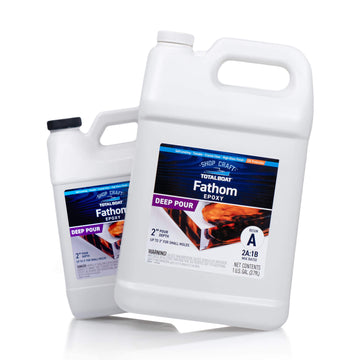

Fathom Deep Pour Epoxy Resin Kits
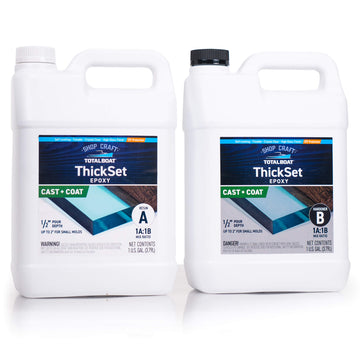

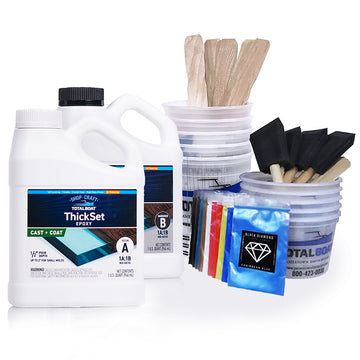
ThickSet Cast + Coat Deep Pour Epoxy Resin Kits
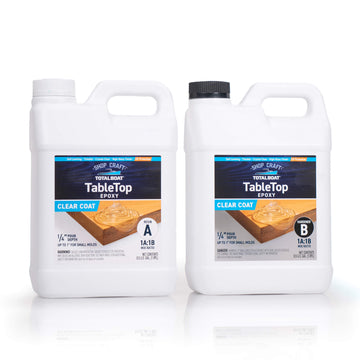


Epoxy River Table Project Kits



2 comments
Want to turn vases 8 in in depth 6in diameter mix resin and wood can do it in single pour and best resin or epoxy to use thanks
a year ago I got resin for a table top.did not know it then
I used it on my paintings pour paints.
it was hard putting 2 coats on as I have trouble moving so much turned out ok.
a year later I am wanting to do my winter pictures
can I use it again in thin layers
can you help advise how thick and how many layers
its a little hard to cover cells in one layer I will be waiting to here as I was setting up when I saw I had the wrong kind
do I need the heat 75 degrees for 3 days ! PLEASE HELP