











Composite Fabrics 101
Fiberglass, Carbon Fiber & Kevlar Explained
Tackling repairs and building anything out of composite materials can be intimidating, especially if you’re a beginner. If you’re looking to patch your boat’s hull, wet out a paddle board, fabricate components, or reinforce anything structural, this guide can help you get started.
We’ll focus on some of the most common composite fabrics used in the marine, woodworking, and maker space: fiberglass, carbon fiber, and Kevlar. Each one offers unique strengths and considerations, with some working better for certain projects or with epoxy resin versus polyester resin.
What Is a Composite Material?
Composites offer the strength and benefits of two or more materials together, with fiberglassing as a classic example. By combining fiberglass cloth with a resin, the final product is stronger, stays light, and helps prevent damage from impact or marine conditions.
These combined materials are everywhere, from boat hulls and kayaks to car bodies, drone frames, sporting equipment, and architectural panels. The most common reinforcement fabrics you’ll encounter are fiberglass (made with thin glass filaments), carbon fiber (carbon crystal filaments), and Kevlar (synthetic aramid filaments). The right choice for your project will depend on what you’re building and what environmental factors and physical stress it will bear after completion.
Each one has unique considerations, such as which resin types they work with, so it’s important to understand and compare to determine the right base fabric for the job.
What Is Fiberglass?
Fiberglass is the workhorse of the composite world. It's been the foundation of boat building and auto repairs since the 1950s, and for good reason. It's affordable, versatile, easy to work with, and genuinely strong.
How Fiberglass Is Made
Fiberglass starts as molten glass that's drawn into extremely fine filaments that are thinner than a human hair. Those filaments are bundled into yarns, which are then woven, stitched, or compressed into fabric form. The result is the familiar white cloth you'll find in rolls at any marine supply or hardware store.
Fiberglass is one of the most versatile composite materials out there making it at home on the water and well beyond it.
Marine:
- Hull repairs and full hull construction
- Deck repairs and rebuilds
- Canoe and kayak construction
Beyond the water:
- Automotive body panels, fairings, and custom car parts
- Surfboards, skateboards, and other recreational equipment
- Architectural panels, enclosures, and custom molds

Fiberglass repair by Restro Thunder Road
Fiberglass Fabric Weights: What to Use and When
Fiberglass cloth comes in a range of weights, measured in ounces per square yard. Lighter fabrics are thinner and more pliable; heavier fabrics add more structural bulk per layer. Choosing the right weight depends on your application. For fiberglass lamination, we offer a handy resin calculator to help estimate how much resin you need based on fabric type and weight.
- 4 oz. cloth — Lightweight and nearly transparent when cured. Ideal for protecting wood surfaces (canoe hulls, kayak decks, wooden boat topsides), applying over foam, or adding a final wear layer without adding significant weight.
- 6 oz. cloth — A versatile middle-ground weight. Good for general repairs, moderate reinforcement, and applications where you want more strength than a 4 oz. provides without going full structural.
- 10 oz. cloth — A heavier, more substantial fabric suited for structural layups, hull construction, and applications requiring more laminate thickness per layer.
Biaxial and multiaxial fabrics are a step up from standard woven cloth. Instead of a simple over-under weave, biaxial fabrics layer fibers at ±45° angles, sometimes with an additional 0°/90° layer, and stitch them together. This construction gives you excellent strength in multiple directions, making it particularly well suited for structural tabbing, keel areas, hull repairs, and anywhere loads come from different angles.
Fiberglass mat is a non-woven material made from randomly oriented chopped glass strands. It's used primarily to add bulk, build thickness quickly, or fill irregular shapes where drape and conformability matter more than directional strength. Mat is commonly used in production boat building and mold construction.
Fiberglass tape is simply pre-cut cloth in a narrow strip, typically 2 to 6 inches wide, designed for reinforcing seams, joints, and fillets. It's a staple for any boatbuilder working on a stitch-and-glue project or seaming planks.
Pro Tip: For bonding fiberglass cloth to wood, or for any marine structural repair, epoxy resin is the preferred system — it bonds more aggressively, is more waterproof, and pairs better with most modern fiberglass fabrics than polyester. More on choosing the right resin below.

The Strengths of Fiberglass
Fiberglass starts as molten glass that's drawn into extremely fine filaments that are thinner than a human hair. Those filaments are bundled into yarns, which are then woven, stitched, or compressed into fabric form. The result is the familiar white cloth you'll find in rolls at any marine supply or hardware store.
- Cost-effective: Of the three materials covered here, fiberglass is consistently the most affordable , especially for large builds or extensive repairs.
- Easy to use: It wets out readily with both epoxy and polyester resin, conforms well to curved surfaces, and is forgiving enough for beginners.
- Good overall strength: Fiberglass has excellent tensile and compressive strength for its cost. It handles flexing and moderate impacts well.
- Corrosion resistant: Glass fibers don't absorb water or rust, which makes fiberglass laminates a natural fit for wet marine environments.
- Various weaves and forms: Woven cloth, biaxial fabric, mat, tape — fiberglass comes in a range of formats suited for different layup methods and structural needs.
Things to keep in mind:
- It's heavier than carbon fiber. Pound for pound, fiberglass doesn't match carbon's stiffness-to-weight ratio. For performance-driven builds, that difference matters.
- Print-through is possible. On thin or highly polished laminates, the weave pattern can telegraph through the surface finish — something to plan for on cosmetically sensitive work.
- Not as stiff as carbon. In high-load structural applications, fiberglass will flex more than carbon fiber under equivalent stress.

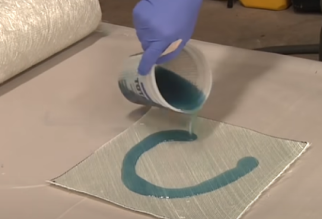
Totalboat 5:1 Traditional Epoxy Resin being used with fiberglass
A Note on Dynel
Worth mentioning alongside fiberglass is Dynel, a synthetic fabric made from modacrylic fibers. Dynel isn't fiberglass, it's in a category of its own, but it's frequently used in the same contexts.
Its big advantage is exceptional abrasion resistance. For canoe and kayak hulls, skids, and any surface that regularly drags over rocks or rough bottoms, Dynel outperforms standard fiberglass cloth. It wets out easily with epoxy and sands to a smooth finish.
What Is Carbon Fiber?
If fiberglass is the workhorse,
How Carbon Fiber Is Made
Carbon fiber starts as a polymer called polyacrylonitrile (PAN). It's processed through a series of high-heat treatments (oxidation and carbonization) that strip away everything except tightly bonded carbon atoms. The result is a fiber with an extraordinary stiffness-to-weight ratio, far higher than any glass fiber.
Those carbon filaments are woven or stitched into fabric, most commonly in plain weave (a classic over-under pattern) or twill weave (a diagonal pattern that's easier to drape over complex curves).

Common Uses
Carbon fiber earns its cost wherever weight and stiffness are at a premium.
Marine:
- Racing sailboat hulls, masts, booms, dories and spars
- Rudder blades, centerboards, and high-performance structural components
- Performance kayak and canoe paddles
Beyond the water:
- Aerospace and automotive components (drone frames, race car chassis, bicycle frames)
- Sporting equipment — hockey sticks, golf shafts, skate decks, and tennis rackets
- Custom enclosures, panels, and cosmetic overlays where the look is part of the design
The Strengths of Carbon Fiber
- Exceptional strength-to-weight ratio. This is carbon's headline feature. It's roughly 5times stronger than steel at a fraction of the weight.
- High stiffness (modulus). Carbon fiber resists flex better than fiberglass or Kevlar. For structural components where deflection matters like a mast, a rudder blade, or a beam, that stiffness is extremely valuable.
- Lightweight. Carbon laminates weigh significantly less than equivalent fiberglass structures. For performance-oriented marine builds, this translates directly to speed, handling, and efficiency.
- Distinctive appearance. The woven carbon pattern has become a distinct aesthetic in its own right. Left under a clear finish, it looks sharp.
Things to keep in mind:
- It's brittle under point impact. Carbon fiber is stiff but not particularly tough. It doesn't absorb impact energy as well as Kevlar or even fiberglass and it tends to crack or delaminate under a sharp localized hit rather than deforming and rebounding.
- It's expensive. The manufacturing process is intensive, and the cost reflects that. Carbon fiber cloth typically runs 5–10x the price of equivalent fiberglass, depending on the weight and weave.
- Epoxy is the right resin for almost every application. It bonds well to carbon fiber and delivers the mechanical properties the material is capable of. Polyester and vinylester resins can be used for non-structural or cosmetic applications, but they don't bond as reliably and aren't appropriate where strength and stiffness matter.
- It conducts electricity. Carbon fiber is electrically conductive which is something to be aware of if you're building anything near electrical systems or metalwork prone to galvanic corrosion.
What Is Kevlar?
Kevlar is the brand name for a para-aramid synthetic fiber developed by DuPont. It's become synonymous with toughness and that reputation is well-earned. Where carbon fiber excels at stiffness,
How Kevlar Is Made
Like carbon fiber, Kevlar starts as a polymer but in this case, a liquid crystalline polyamide that's extruded into fibers. Those fibers are incredibly strong in tension, and more importantly, they resist tearing and shredding under impact in a way that glass and carbon simply don't.
Kevlar fabric comes in several forms: plain weave (symmetrical, balanced, good for general applications), twill weave (more drapeable, better for complex curves), and tape (narrow strips for localized reinforcement).
Common Uses
Kevlar earns its place anywhere impact protection and toughness are the priority.
Marine:
- Canoe and kayak hulls (particularly whitewater boats and tripping canoes)
- Leading edges, bow stems, and skeg protection
- Keel areas and high-wear hull surfaces on sailboats
Beyond the water:
- Protective gear and hard-shell cases where impact resistance is critical
- Drone frames and UAV components that need toughness without excess weight
- Reinforcing panels in automotive and industrial builds subject to vibration or impact
Pro Tip: Kevlar tape is a practical way to add targeted impact protection to high-wear zones — bow stems, keel rocker areas, canoe gunwales — without committing to a full Kevlar layup.
The Strengths of Kevlar
- Outstanding impact and abrasion resistance. This is the defining property that sets Kevlar apart. It absorbs impact energy through fiber deformation rather than fracture, making it ideal for areas that take hits.
- High tensile strength. Kevlar is exceptionally strong, stronger than fiberglass by a wide margin, and competitive with carbon in some configurations.
- Lighter than fiberglass. Kevlar laminates weigh less than equivalent fiberglass structures, though they're slightly heavier than carbon.
- Tough where carbon is brittle. Kevlar and carbon fiber are frequently combined in hybrid laminates precisely because their properties complement each other — carbon provides stiffness, Kevlar provides toughness and impact resistance.
Things to keep in mind:
- It's difficult to cut and sand. Aramid fibers are notoriously hard to trim cleanly. Kevlar cloth requires very sharp scissors or a rotary cutter (standard scissors will tear rather than cut it), and it essentially cannot be sanded smooth because the fibers fuzz up rather than abrade. Finishing edges on Kevlar laminates requires trimming with sharp tools before the resin cures, or grinding and covering with a layer of fiberglass.
- Poor compression strength. Kevlar performs well in tension but not as well in compression. Most structural laminates using Kevlar pair it with fiberglass or carbon fiber layers to cover this weakness.
- It doesn't bond as readily under compression. Because Kevlar fibers are difficult to fully saturate and tend to rebound slightly, achieving a fully consolidated laminate requires good wet-out technique.
- The yellow color shows through. Kevlar is a bright golden-yellow. Under a clear finish, that color is very visible. If final appearance matters, plan your surface layer accordingly.
- Use epoxy. Like carbon fiber, Kevlar performs best when laminated with epoxy resin.
Choosing Your Resin: Epoxy vs. Polyester
The reinforcement fabric is only half of the equation, the resin system you use to wet it out matters just as much.
Marine Epoxy
Epoxy is the preferred resin for composite work in virtually every modern marine context. It offers superior adhesion to most substrates, excellent water resistance (a big deal below the waterline), minimal shrinkage during cure, and the best mechanical properties of any resin system. For carbon fiber and Kevlar, epoxy isn't just preferred, it's really the only viable choice.
When it comes to marine epoxies, it is important to note that some produce an amine blush. Amine blush is a waxy coating that forms on the surface of epoxy as it cures that must be washed off before additional coatings are applied. Alternatively, you can choose a clear formula that is blush-free like TotalBoat High Performance Epoxy.

Polyester Resin
Polyester resin is the traditional choice for fiberglass boat construction and has been used successfully for decades. It's less expensive than epoxy, cures faster in production environments, and works well with chopped strand mat (which actually bonds better with polyester than with epoxy due to the binder used in mat production). For straightforward fiberglass repair work like patching a hull, or reskinning a deck, polyester can be a practical and cost-effective option.
For carbon fiber or Kevlar work, epoxy is the right choice — polyester can be used in non-structural or cosmetic applications, but it isn't appropriate where the full mechanical potential of those materials needs to be realized.
Pro Tip: If you're doing a structural repair, bonding dissimilar materials, working below the waterline, or using carbon or Kevlar fabric, use epoxy. If you're doing a straightforward fiberglass repair on an existing polyester laminate and cost is a primary consideration, polyester is a workable option, though epoxy will give you a stronger bond.
So, Which Material Is Right for Your Project?
Here's a plain-language decision guide for the most common scenarios:
You're repairing a fiberglass boat hull or deck: Fiberglass cloth or biaxial fabric is almost certainly your answer. Match the weight of your repair fabric to the weight of the existing laminate where possible, and use marine epoxy for the best bond.
You're building a canoe or kayak from scratch: Fiberglass is the typical starting point — affordable, easy to work with, and plenty strong. If you're building a performance or whitewater boat, consider a Kevlar layup for the hull skin, or a hybrid of Kevlar with fiberglass. Add Dynel to the hull bottom if abrasion resistance is a priority.
You're reinforcing impact zones (bow stem, keel, skeg area): Kevlar is your friend here. Even a few layers of Kevlar cloth or tape in a high-wear zone adds significant impact and abrasion protection over a standard fiberglass layup.
You're building or repairing a performance component — mast, rudder, racing hull: Carbon fiber. The weight and stiffness advantage justifies the cost when performance is the goal.
You're working on a budget repair and don't need to optimize for weight: Fiberglass with a good marine epoxy is the most cost-effective, practical, and widely available solution for the majority of marine repair and construction work.
The Right Material Makes All the Difference
Fiberglass, carbon fiber, and Kevlar are three different answers to the same basic question: how do I build something strong, light, and durable? Fiberglass gives you accessibility and versatility. Carbon fiber gives you stiffness and performance. Kevlar gives you toughness and impact resistance. Most real-world projects lean on one primarily, while borrowing from the others where it makes sense.
Understanding these differences doesn't just help you pick the right material — it helps you understand what's actually happening when you do a layup, why certain products are built the way they are, and how to make smarter choices the next time you're standing in front of a project that needs structural work. Whether you're on the water or in the workshop, the right composite starts with knowing your options.
Stock Up on Supplies
Explore TotalBoat's full range of fiberglass and composite materials, and if you have questions about what to use for a specific project, our support team is a great resource.
- Choosing a selection results in a full page refresh.