









If you’ve been following Sailing Parlay Revival, you know that Colin MacRae and his crew are no strangers to serious fiberglass work. But in their latest episode, "REBUILDING OUR HULLS: Blister repair series - part 4," the team finds themselves in Rebak Island Marina, Malaysia, opening what Colin calls an "absolute can of worms" on the bottom of their Lagoon 450 catamaran.
What started as a routine investigation into a few blisters has turned into a full-scale hull rebuild. For anyone facing hull moisture issues or planning a bottom job, this episode is a masterclass in troubleshooting, grinding, and building back stronger with epoxy.
The Moisture Meter Reveals the Truth
The episode begins with a hard reality check. While grinding out what looked like surface blisters along the centerline, Colin discovered deep voids, uncured resin from the factory infusion process, and trapped water spraying out of the laminate. He keeps chasing readings, going “deeper, deeper, deeper,” until he hits the real problem: hidden cavities and moisture that would have been easy to miss if he’d stopped at the first couple layers.
The moisture meter proved to be the MVP of this haul-out.
“I wouldn't have picked that up without the moisture meter… it really helped me locate this water and uncured resin and this big void.” — Colin MacRae
Rather than waiting months for the hull to dry out naturally, the crew decided to take the aggressive route: grind out every inch of compromised fiberglass until they reached “bone dry” laminate, then rebuild it from scratch.
Building Back Stronger with TotalBoat
The goal for this refit isn’t just to patch the boat, it’s to reinforce it. Colin walks through how the boat was built (gelcoat in the mold, glass laid over it, balsa core in the sandwich, then vacuum infusion with catalyzed polyester), and why that process can hide voids and defects you’ll never see until you start grinding.
To rebuild the damaged areas below the waterline, the team replaces the original polyester layup with high performance epoxy. In his words, they’re not trying to “dry it out and hope,” they’re removing what’s compromised and rebuilding with a stronger system.
“It’s going to be an epoxy reinforced hull and there will never ever be another blister on this hull after we're done with it.” — Colin MacRae
That line is classic Colin confidence, and it lands in the video because you will watch the amount of work it takes to earn it!
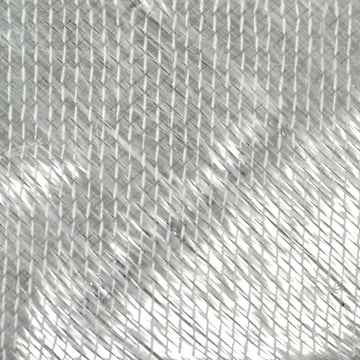
To tackle the massive layup in Malaysian heat, the team used High Performance Epoxy with Slow Hardener. Working time matters here, because they’re wetting out large 1708 biaxial fiberglass sections and putting them up overhead. Once the resin starts kicking, it’s game over for clean layup, so they’re mixing big batches, then splitting them out to keep heat down and time on their side.


The Process: TotalFair, Wet-on-Wet, and a Four-Person Glassing Sprint
Before the glass could go on, the team had to prep the surface so they weren’t sealing new voids into the repair. They used TotalFair Epoxy Fairing Compound to fill pinholes, cavities, and low spots from the factory layup, basically anything that could trap air under the new laminate.
Then comes the move that makes this episode so satisfying to watch: they glass over the fairing while it’s still wet. Colin spells it out plainly, if they filled yesterday, they’d have to grind it back before glassing. Doing it wet-on-wet means it all chemically bonds together in one continuous build.
And that continuous build is the whole point of their plan. Colin explains they’re doing the layup “all in one hit” specifically to keep a chemical bond between layers, instead of stopping, curing, and having to grind for a secondary bond.

This is also where the video becomes a legit team sport. It’s a four-person job, and it has to be.
-
One person is mixing the next batch while the others are laying cloth
-
They wet out the fiberglass before it goes up
-
They roll it into position overhead, where it wants to sag or stretch
-
Then they work it with an air roller to drive out bubbles and squeeze out excess resin, which Colin notes reduces weight and results in a stronger laminate
The overhead part is what raises the difficulty. The cloth wants to fall, saturated fiberglass can stretch, and big pieces require synchronized hands. Colin even calls it out mid-layup: “This next one’s a big one. Glad you got four people.”
When it’s going well, you can feel the momentum shift from misery to progress.
“The grinding wasn't the fun part, this is the fun part. This is when you actually feel like you've really accomplished something.” — Colin MacRae
By morning, the epoxy is “cured rock solid,” and Colin’s stoked. They’ve built up more glass than was originally there in spots, and now it’s time to buzz edges, blend the thickness, and get the hull shape back where it belongs.

Polyester vs Epoxy, and Why Gelcoat Changes the Plan
Near the end, Colin drops a super useful reminder for anyone doing their own repairs: product choice depends on where you’re working and what finish you need.
Below the waterline, they’re not bothering with gelcoat. They’re rebuilding with epoxy, then plan to top it with barrier coat, then antifoul. It’s about strength, sealing, and a system designed for staying underwater.
Above the waterline, it’s a different story. Colin explains they’re switching back to polyester for the above-water repairs because they want a gelcoat finish there. He points out the compatibility issue plainly: they don’t want to put gelcoat over epoxy, but epoxy can go over polyester.
That quick explanation is easy to miss, but it’s one of the more practical “listen up” moments in the episode. It’s not just what you use, it’s what you’re planning to put on top of it.
A Rudder Awakening
Just when things seem to be moving forward, the moisture meter lights up again, this time on the rudders. No blisters, no obvious damage, but the readings say wet. Colin cuts one open and finds water trapped between the foam and the fiberglass skin, along with separation at the leading edge that compromises strength.
Once again, the theme holds: you can’t judge what’s happening inside fiberglass by the outside surface alone.

Looking Ahead
By the end of the episode, the port bow repair is rebuilt, cured, and “rock solid.” The structure is back, and the strategy is clear: rebuild the problem areas correctly, then lock it down with a barrier coat system before they go back to bottom paint.
If you want to see how Colin has used TotalBoat products to protect Parlay’s hull in the past, check out our previous feature on Sailing Parlay Revival in the Boatyard, where they applied our Spartan bottom paint. Or catch up on their remote repairs in the Hermit Islands, where they used our products to keep local boats running.
Check out the full episode below to see the grinding, the glassing, and the grit it takes to keep a world-girdling catamaran floating!
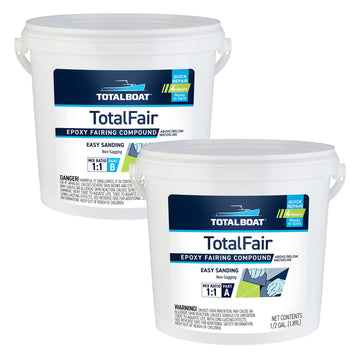
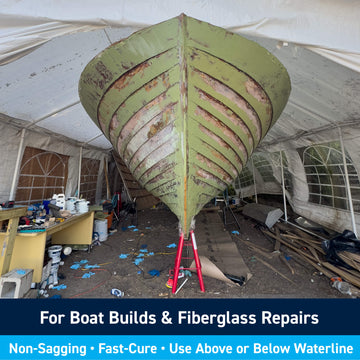
TotalFair Epoxy Fairing Compound
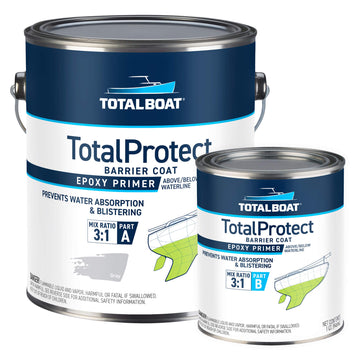
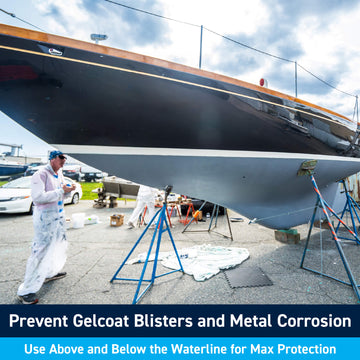
TotalProtect Epoxy Barrier Coat Primer

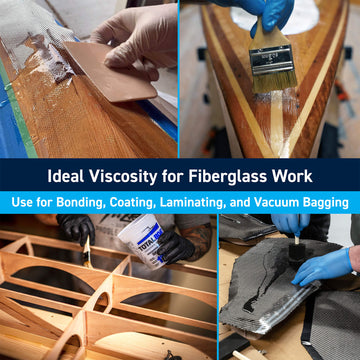
Clear High Performance Epoxy Kits
Men’s Long Sleeve T-Shirt Hoodie


