










Jacob Knowles has been fishing the waters off Prospect Harbor, Maine, his entire life. He grew up in a commercial fishing family and learned the trade the way most do — by watching, doing, and passing it down. So when it came time to prep his new lobster boat for launch, he wanted to do something he'd never actually done before: bottom paint it properly.
That meant a road trip from TotalBoat HQ. Mike Mills (aka "Mr. TotalBoat"), Kristin, and Megan packed up and headed to the coast of Maine to help Jacob tackle one of the most important and most underestimated steps in any new boat prep: protecting the bottom.
More Than Just Paint
Jacob opens the video with a confession: for most of his life, he thought bottom painting was simple. Scuff it up, roll on some paint, call it good. It's how his family always did it, and it worked well enough.
But "well enough" has a cost. A dirty bottom fouled with barnacles, grass, and growth can rob a working boat of a knot or two of speed. When you're running 20 to 30 miles a day hauling traps across Maine's cold Atlantic, that adds up fast. Jacob estimates it translates to thousands of extra dollars in fuel over the course of a season.
So for his new boat, he wanted to get it right from the start.
The TotalBoat Crew Arrives
When Mike, Kristin, and Megan pulled up to the shop, the boat was already on stands — a serious vessel, bigger in person than most expect. Jacob jokes that calling it "a boat" might be underselling it a little.
What followed over the next couple of days was a masterclass in bottom prep, done in layers and done properly, with a crew that clearly loves what they do.

Step One: The Barrier Coat
The most important thing the TotalBoat team brought with them wasn't a product — it was knowledge Jacob hadn't had before.
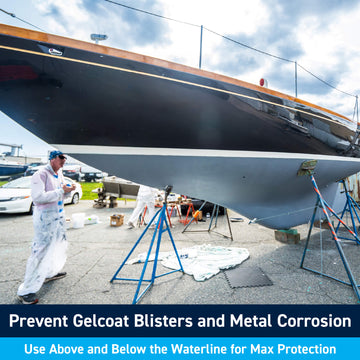
He'd never applied a barrier coat prior to this. Most boaters haven't. But here's why it matters: gelcoat, despite appearances, is not fully waterproof. Saltwater can slowly seep through it, cause blistering, and eventually compromise the hull from the inside out.
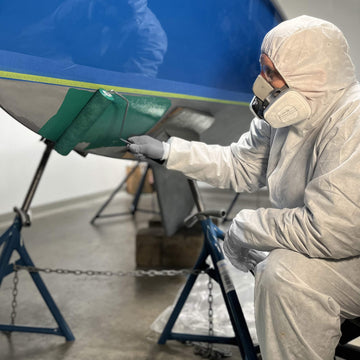
The solution is TotalProtect Epoxy Barrier Coat Primer, a two-part epoxy applied directly over the gelcoat before any bottom paint goes on. It creates a fully watertight seal, protects the gelcoat from osmotic blistering, and gives the bottom paint a far better surface to bond to, resulting in a system that lasts significantly longer than bottom paint applied directly to gelcoat.
The team applied four coats of barrier coat in total, and they tinted each coat slightly differently — starting with white, then shifting through progressively darker shades of gray. As the layers wear over time, Jacob can see exactly how deep into the system he is. When white starts showing through, it's time to re-evaluate. It's a built-in wear indicator, and it's the kind of practical thinking that separates a rushed bottom job from a lasting one.
"No salt water can get to the fiberglass now," Jacob says, surveying the finished barrier coat. "There's a protective barrier — which is what the barrier coat is for."

Step Two: Krypton Bottom Paint
With the epoxy system locked in, the team moved on to TotalBoat Krypton, an ablative copper bottom paint, and the part of the process that trips up a lot of boaters.
The counterintuitive truth about ablative bottom paint is that you want it to come off. As the boat moves through the water, the outer layer slowly wears away, taking any growth or fouling with it. Fresh, active copper is always being exposed at the surface, so the paint functions as a self-cleaning system in motion rather than just a static barrier.
The team applied the bottom paint in multiple coats, starting with black to build a solid base before carefully mixing a custom final color to match the boat's aluminum components. Jacob wanted the bottom to visually tie into the bare aluminum mast, booms, trap rack, and tailgate extension that would remain unpainted on the finished boat. No premixed color quite fit the vision, so the team dialed it in by hand — two gallons of white, one quart of black, stirred slowly, and checked against the actual aluminum until they landed on a battleship gray that Jacob called "very close to perfect." Three to four coats of Krypton went on in total, giving the bottom serious protection depth that Jacob won't have to think about for seasons to come.

The Little Details That Add Up
Between coats, the shop was alive with activity. Chuck was sanding and prepping the topside for paint. The hauler backing plate was getting fitted. An electrician was getting ready to start on the wiring.
Watching Mike, Kristin, and Megan work alongside Jacob's crew — sharing tips, catching roller marks, mixing shades, and talking through decisions in real time — feels less like a brand visit and more like exactly what it was: people who genuinely care about boats helping someone do right by a new one.

Why Proper Bottom Paint Prep Matters
Jacob has grounded out his current boat more times than he can count, pulling it up on the beach at high tide, propping it with a crab stand, and scraping barnacles as the water recedes. It works, but it costs a full day every time, and he's often running with a fouled bottom for stretches of the summer anyway.
The system going on his new boat — barrier coat followed by multiple coats of Krypton — is designed to minimize all of that. Less time grounding out, less fuel burned pushing through growth, and more time on the water doing what the boat was built to do.
"Every little bit of effort we put into doing this right now," Jacob says, "the more fuel savings there will be over the next few years."
A little extra work upfront, done properly with the right products and the right people, and a lobster boat that's ready to perform from the moment it hits the water.
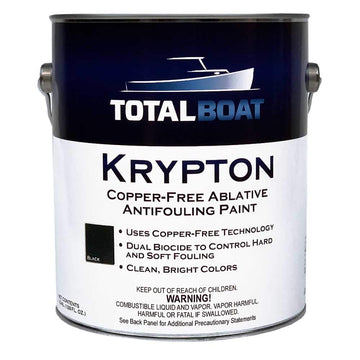

Krypton Copper-Free Boat Bottom Paint
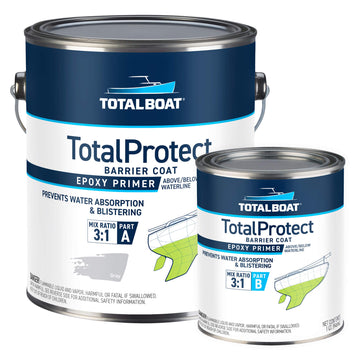
TotalProtect Epoxy Barrier Coat Primer
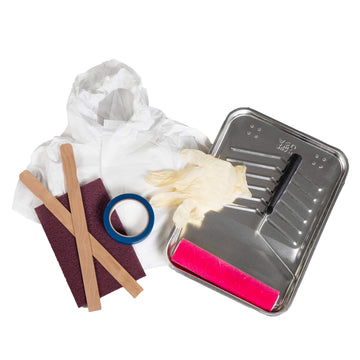
Antifouling Bottom Paint Supplies Kit


