









If you've been following Sailing Parlay Revival, you know that Colin MacRae doesn't back down from a challenge. But in his latest episode, "THIS IS THE LAST THING ANY BOAT OWNER WANTS TO FIND," the scope of the blister repair on their Lagoon 450 catamaran keeps growing — and so does the work. Docked at Rebak Island Marina in Malaysia, the crew is deep into rebuilding both hulls along the entire centerline, and this episode is packed with the kind of real-world fiberglass knowledge you just can't get from a textbook.
Bow Repair: Building Stronger Than Factory
The episode kicks off at the bow, which took a hit from a log at some point in Parlay's storied past. Colin's approach here is simple: if you're already rebuilding it, build it better. They're laying up 20 layers of glass on the bow — significantly more than what was originally there — turning a damaged section into arguably the strongest part of the hull.
The resin choice for the bow repair is polyester, for a specific reason: above the waterline, they need to spray gelcoat over the finished repair, and as Colin explains, gelcoat bonds better over polyester than over epoxy. Below the waterline, they'll tie the polyester into their existing epoxy layup to add even more strength down to the waterline.
"She's going to be strong."
Before any glass goes on, the team fills pinholes and voids with thickened resin to prevent air bubbles from getting trapped in the laminate. Then it's time lapse mode — wet out, lay up, roll out bubbles, and repeat.
Epoxy vs. Polyester: Knowing When to Use Which
One of the most genuinely useful parts of this episode is Colin's plain-English explanation of why they keep switching between epoxy and polyester at different points on the hull. The short version: below the waterline gets epoxy because it's waterproof, and polyester resins and gelcoats are not. Above the waterline, they use polyester where gelcoat needs to go on top, since gelcoat adhesion to epoxy is less reliable.
It's the kind of nuance that matters enormously for anyone planning their own repair — and it's easy to get wrong.
Along the keel, which had blisters and moisture through the bottom foot or so, they ground out about three layers of compromised glass and replaced it with four layers of biaxial glass and epoxy. Again, coming out stronger on the other side.
A Note on Fiberglass: When You Can't Get the Good Stuff
Here's something most repair guides won't tell you: you might not always be able to get the materials you want, especially when you're in a remote corner of Southeast Asia.
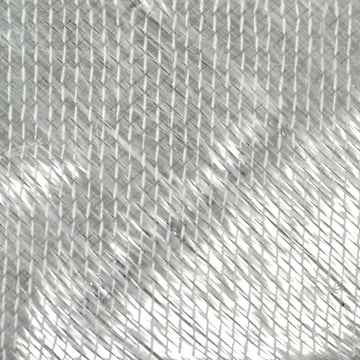
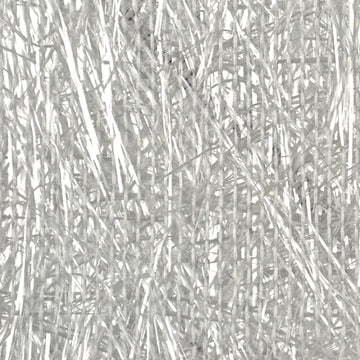
Colin gives a shoutout to our 1708 Biaxial Fiberglass — 17 oz of biaxial glass plus an 8 oz backing mat, which he calls the strongest fiberglass combo you can get. But they ran out of it, and locally sourced materials came with a catch: the chop strand mat (CSM) available in Malaysia has a styrene-based binder that works well with polyester resin, but creates problems with epoxy. The styrene breaks down with polyester, but with epoxy it just makes the material stiff and difficult to work with.
Their solution: switch to straight biaxial glass without the mat for all their epoxy work. Since the locally available biaxial is 14.5 oz rather than the 17 oz of the 1708, they compensate by adding an extra layer — four layers instead of three — to match the original build thickness.
It's a great reminder for anyone doing epoxy work: if you're using CSM, check whether it has a binder in it. If it does, it's designed for polyester.
Fairing Below and Above the Waterline
With the glassing making serious progress, the crew started fairing repairs that were ready. And once again, the product choice changes depending on where they are on the hull.
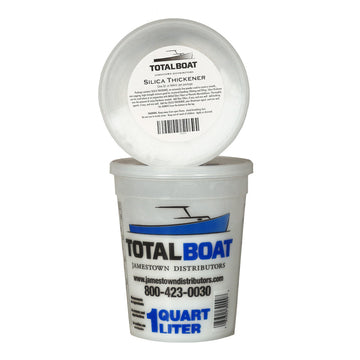
Below the waterline, Colin mixed up a custom fairing compound using High Performance Epoxy as the base, then added silica thickener for strength and a touch of milled glass fiber to create a dense, structural paste. They also had some TotalFair Epoxy Fairing Compound on hand for areas where a pre-made mix made sense.
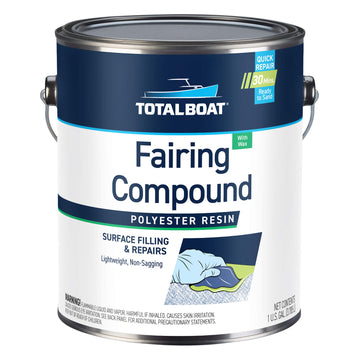
Above the waterline, it's a different priority — easy sanding and a smooth surface for gelcoat. For the transition zones where a repair crosses from above to below the waterline and the whole area is polyester, Colin reached for Polyester Structural Repair Putty, which has fiberglass reinforcement built in. The goal throughout: as much strength as possible without turning the boat into a brick.
One critical tip Colin shares for fairing above the waterline: the structural putty doesn't contain any air-drying agents, so he added wax to create a barrier between the compound and the air. Without it, the surface won't fully cure — a small detail that makes a big difference in the finish.
The plan below the waterline is to build up to TotalProtect Epoxy Barrier Coat over the epoxy fairing, then antifoul on top. Nothing is getting back in.


What's Next
By the end of the episode, the starboard bow is glassed, the keel is nearly done, and the port bow is faired and ready for barrier coat. There's still one section near the engine room that's reading slightly damp on the moisture meter after a month of drying — they're giving it a couple more weeks before glassing, which is the right call.
Colin also teases what's coming next week: a raw, unedited, three-camera take on one of the most challenging overhead glassing sections yet. No cuts, no time lapse — just the clock ticking and resin going off in Malaysian heat.

If you want to catch up on how this repair project got started, check out our previous feature on Sailing Parlay Revival's hull rebuild, or revisit their earlier work in their repairs in the Hermit Islands.
Watch the full episode below!



Clear High Performance Epoxy Kits

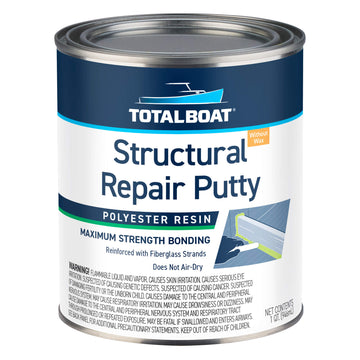
Polyester Structural Marine Repair Putty
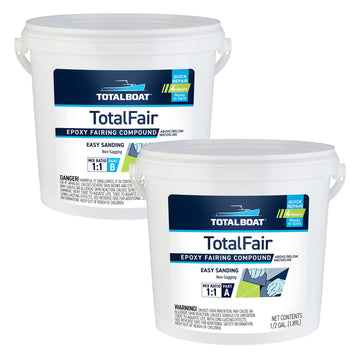
TotalFair Epoxy Fairing Compound


