









Raff and Sasha, the modern-day pirates behind Spear It Animal, are back at it in Grenada, and this episode finds them making a decision most refitters would lose sleep over: cutting the boat open even further to build the layout they actually want. What started as hurricane repair work has turned into a full redesign, and the crossbeam and bow section leans on TotalBoat High Performance Epoxy and Thixo Fast Cure to hold it all together. 😉
From Refit to Redesign
Every refit reaches a point where the original plan stops making sense, and for Raff and Sasha, that point arrived somewhere around their third bulkhead. The catamaran had already survived a hurricane, a flip, fifty-three days stranded, and a forty-mile tow to Grenada. Once they started opening up the port forward cabin, they realized a couple of small twin berths and a cramped storage hatch were not going to cut it for the boat they wanted to sail around the world.
So they cut. A watertight bulkhead became a doorway. A hatch became a walk-in utility room with cabinets, a hanging locker for line and fenders, and a full-length door that still seals watertight when closed under sail. It is a bigger commitment than patching the original layout, but Raff put it simply: this is their last boat, so they are building it exactly the way they want it.
Reinforcing the Bow, One Backing Plate at a Time
Before any of that redesign could happen, the crossbeam and bow needed serious structural attention. This beam carries the entire load of the rig, and the crew had already found evidence of a previous owner cutting corners around it. Raff and Sasha were not about to repeat that mistake.
They started by salvaging fiberglass panels from the boat's old shower stall to build a new backing plate for the bow. Reused material, properly bonded, gave them a solid foundation to glass over and re-drill.
Then came a smaller but equally important repair: gluing the original hatch cutout pieces back into the hull so the surface sat flush before glassing. That job called for Thixo Fast Cure, and it is a good example of exactly what this product is built for.

Here's how they used it:
- Fill the void first. Any hollow space behind the wood gets packed so it will not compress when hardware gets bolted down later. Raff filled the gap with thickened epoxy, then pressed in foam to control how much epoxy sat in the cavity.
- Dispense and apply. Thixo Fast Cure comes in a cartridge with a static mixing nozzle, so resin and hardener blend automatically as it comes out. Raff ran a bead right along the edge of the piece.
- Seat and squeeze. The hatch piece gets pressed into place and squeegeed tight, with a scrap of plastic and a support board holding it flat while it cures.
- Save what you do not use. Twist the cap back on, swap in a fresh nozzle next time, and the rest of the cartridge is ready for the next job.
For a crew working through a boat this size, that last point matters. Nobody wants to burn through a whole cartridge on a job that only needed a few inches of glue line.


Building Strength with High Performance Epoxy
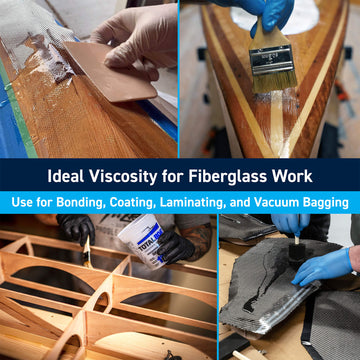
Once the backing plate and bow section were prepped, the real glassing session began, and this is where High Performance Epoxy carried the load. Sasha mixed batches and thickened them with glass fibers and silica so the epoxy would spread into gaps and crevices instead of running off overhead surfaces. Raff laid up the fiberglass and rolled out the bubbles while working in pairs, passing wetted panels back and forth in an evening session that stretched well past sunset.

The crew put three layers of glass on the cross beam section and the backing plate, then repeated the process where the deck met the newly cut doorway. They filled the gaps with thickened epoxy first and layered fiberglass over it while that base coat was still wet, which creates a chemical bond between the layers instead of a weaker mechanical one. Peel ply went over every section, both to smooth the surface and to prep for the next round of glass.

By the time they pulled the peel ply the following day, the payoff was obvious. No visible seams, no amine blush, and a surface solid enough that Raff called it "not going anywhere." Three more layers followed on both the cross beam and the backing plate, bringing the total to six layers of reinforcement tying the bow structure into the rest of the boat.
A Smarter Shelf and a Bigger Vision
With the structural work handled, Raff and Sasha turned to the smaller details that make a utility room actually useful. They scribed and tested shelf shapes directly against the hull curve, landing on a nine-inch shelf on one side and a ten-inch shelf on the other for a layout that reads as even while giving the wider side extra support along the hull.
It is a small decision in the middle of a much bigger project, but it captures how this couple works. Every cut gets tested, every shape gets a mockup, and every choice serves the bigger plan: four cabins, a massive utility room, and a bow strong enough to handle whatever the next ocean crossing throws at it.
Raff and Sasha are proving something a lot of DIY boatbuilders learn the hard way: a refit rarely goes exactly as planned, and the best builds come from crews willing to cut deeper, test their materials, and rebuild smarter the second time around. With TotalBoat High Performance Epoxy and Thixo Fast Cure holding the bow together, this catamaran is well on its way back to sea.
Got questions about thickened epoxy, backing plates, or which Thixo product fits your next repair? Give our tech support team a call at (888) 986-6623, and we will help you get it right the first time.
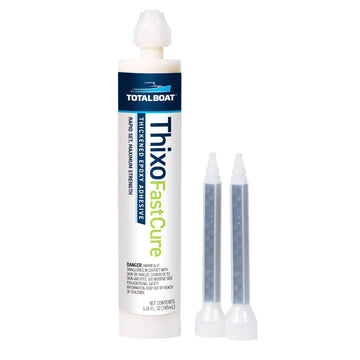

Thixo Fast Cure 2:1 Epoxy Adhesive

Clear High Performance Epoxy Kits


1 comment
Great article! I’ve been there myself,