










How Ambition Strikes Painted the Bottom of Their Aluminum Hull with TotalBoat

Months of grinding, welding, and fabricating all came down to one very long, very fume-filled day.
If you've been following Riley and Courtney Casey of Ambition Strikes, you know the scale of what they've taken on. What started as a "fun winter project" has grown into the most ambitious build of their lives: converting a decommissioned Navy missile patrol boat into a family expedition vessel bound for Alaska. With over a million subscribers watching every setback and breakthrough in real time, their latest video, "Painting Our Aluminum Boat," is the episode the whole community has been waiting for. The hull is repaired, the boat is upside down, and it's finally time to paint!
Why Painting Aluminum Is a Whole Different Game
Here's something most boatbuilders on fiberglass never have to think about: aluminum forms an oxide layer almost instantly once the surface is exposed. And paint does not bond to that oxide layer. This means that from the moment you stop grinding and start painting, you're racing against chemistry.
"Painting aluminum is scary," Courtney says early in the video. The process isn't just roll-and-go. It requires an acid etch to strip the oxide layer, an immediate application window before the oxide reforms, a barrier coat epoxy primer to seal and protect the metal, and finally a copper-free antifouling paint formulated specifically for aluminum. Miss any step or let the timing slip, and you're starting over.
Fortunately, Riley and Courtney didn't have to figure all of this out on their own. "Thankfully, we didn't have to figure all of this out," Riley says in the video. "TotalBoat is helping us out on this project — they figured out what we need and they sent it. They have the complete system from start to finish, and they're helping us figure out which products, how much of them, and how they work together."
Step One: The Acid Wash
With the hull still inverted and the bottom fully exposed, Riley and Courtney suited up — masks, gloves, full protection — and applied TotalBoat Aluminum Boat Etch Wash Cleaner to the entire bottom of the boat. The process took about two hours, with the wind making the spray application trickier than expected. When the rinse came off, the surface transformed visibly: from shiny bare metal to a uniform matte finish that tells you the oxide layer has been chemically removed and the aluminum is open and ready to accept paint.
"Can you guys see how it's like dull now? It was shiny before. Now it's like matte from the acid," Riley points out. That change in appearance is confirmation that the surface prep worked.
The clock started ticking from that moment. The goal was now to get the first coat of barrier primer on within four hours of completing the etch, before the oxide layer can rebuild itself and compromise adhesion.
To get the hull dry fast enough, they brought in heaters and battery-powered fans — propping them directly on the hull to push airflow across the surface. Then came the induction period wait for the two-part epoxy, a cup of coffee, and a deep breath before rolling.

Step Two: TotalBoat Barrier Coat Epoxy Primer
With the surface prepped and the two-part Aluminum Boat Barrier Coat Epoxy Primer mixed at a 3-to-1 ratio (and allowed to sit through its 15-minute induction period for the chemical reaction to begin), Riley and Courtney got to work rolling the bottom.
The short-nap rollers made a noticeable difference. "This is the shortest nap roller I've ever seen," Riley observes. The low nap is intentional as it gives much finer control over film thickness and prevents over-application that can lead to runs or uneven buildup.
First impressions from Courtney rolling the new aluminum sections: "It actually paints on way easier than I thought. It's really nice paint. It's slippery and thick, but not too thick — it self-levels. It sucks into the holes."
That self-leveling behavior is exactly what you want on a welded aluminum hull. Riley explains the three jobs this barrier coat is doing at once on their specific build:
- Adhesion foundation. Antifouling paint won't bond directly to raw aluminum, so the barrier coat gives the antifoul a surface to grab.
- Corrosion protection. The epoxy seals the aluminum against the saltwater environment it's about to spend its life in.
- Leak sealing. This is the one Riley is most excited about. With the boat upside down, gravity is pulling the paint down into any micro-pores, pinholes, or imperfect weld zones — essentially letting the epoxy self-seal from the outside in. "I'm so glad we decided to pump the brakes and do this painting while the boat's upside down," he says. At one point, he watches a small pinhole in a weld literally disappear as the paint flows into it.
Three coats total were planned, with a "thumbprint test" between each — press your thumb into the paint, and if you see the print but no paint transfers, it's ready for the next coat. Two coats went on the first day. The third followed the next morning at 52°F, with the boat pulled further out toward the shop door to help with ventilation after the fumes from the night before had been genuinely rough even with respirators running.
At roughly one gallon per coat for the full bottom, the coverage landed almost exactly where Riley had calculated. Three coats. The bottom of the boat sealed, primed, and ready.

Step Three: TotalBoat Krypton Antifouling Paint — Copper-Free, Aluminum-Safe
Here's where the product choice gets critical in a way that goes beyond application technique. Most antifouling paints on the market use copper as the active biocide that discourages barnacles, algae, and other marine growth. On a fiberglass boat, that's fine. On aluminum, it's a disaster.
"Copper would react with our aluminum and we would literally have an electrolysis reaction between our antifoul and our aluminum," Riley explains. "The copper would be the more noble metal — the paint would eat away the aluminum."
After everything this boat has been through — years of corrosion, a complete transom replacement, months of fabrication — the last thing Riley and Courtney needed was to introduce galvanic corrosion through their own paint job.
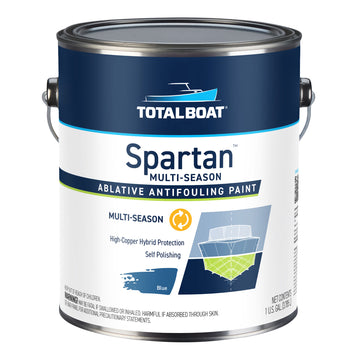
TotalBoat Krypton Antifouling Paint is specifically formulated for aluminum hulls, using a copper-free biocide system that controls both hard fouling (barnacles, mussels) and soft fouling (algae, slime) without attacking the metal underneath. It's also self-abrading, meaning the friction of water slowly wears the paint away over time to continuously expose fresh biocide — keeping the antifouling effect active throughout the season without buildup.
Courtney and Riley applied two coats, working quickly within the application window after the barrier coat. The one wrinkle with a self-abrading paint: the second coat is nearly invisible over the first. "We cannot tell what is coat number one and what is coat number two at all," Riley laughs. But two coats means longer service life before reapplication is needed — an important consideration for a boat heading to remote Alaskan waters.

The Tape Pull — and a Beautiful Surprise
After days of curing, it was time to pull the masking tape off the waterline. It's the moment every boat painter both looks forward to and dreads.
"Oh, dude. That's actually perfect." Riley's reaction says it all. The line is crisp, the transition clean, and the contrast between the dark gray barrier coat and the bare aluminum above it looks genuinely striking — so striking, in fact, that it made them reconsider painting the topsides at all.
"We bought an aluminum boat and we want it to look like an aluminum boat," Riley says. The couple decided on the spot to polish the upper hull rather than paint it, spending several more days working through the sandblasted texture with a metal conditioning drum sander and Scotchbrite pads to bring the aluminum back to a satin brushed finish.
The result was a dark painted bottom, polished aluminum topsides, crisp waterline dividing the two that looks like something that came out of a professional boat shop. Courtney's reaction when she came out to see it says it best: "It looks like a spaceship."

What TotalBoat Made Possible
The system matters. Anyone who has tried to cobble together a bottom paint job from mismatched products — a primer from one brand, an antifoul from another, hoping they're compatible — knows how quickly that can go sideways. What TotalBoat provided for the Ambition Strikes build was a complete, coordinated aluminum bottom paint system: the right etch cleaner, the right barrier coat primer, and a copper-free antifoul designed specifically for metal hulls. Each product chemically compatible with the next, with coverage rates and application windows that actually made sense for the scale of the job.
For a boat that's headed to Alaska, that kind of confidence in the system underneath is essential.
Ready to Paint Your Aluminum Bottom?
Whether you're protecting a jon boat, an offshore center console, or a decommissioned Navy patrol boat, TotalBoat has the complete aluminum bottom paint system engineered for metal hulls, copper-free where it matters, and designed to work as a system from etch to antifoul.
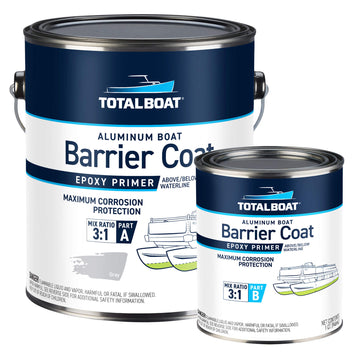

Aluminum Boat Barrier Coat Epoxy Primer
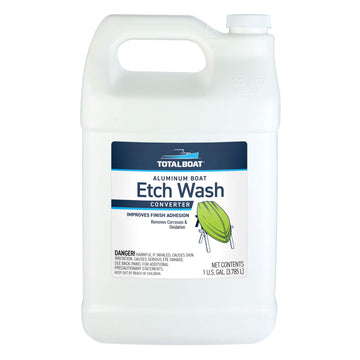
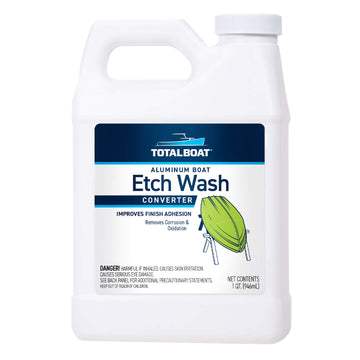
Aluminum Boat Etch Wash Cleaner and Conditioner
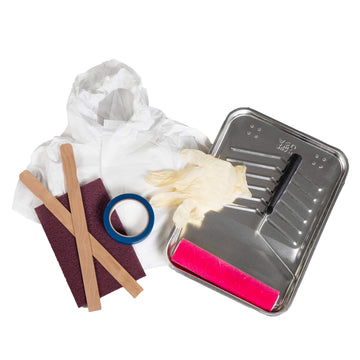
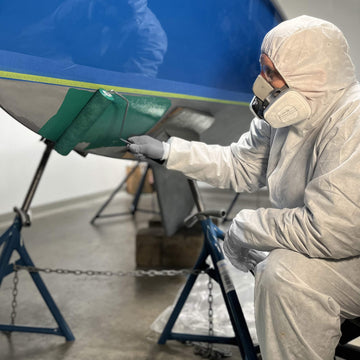
Antifouling Bottom Paint Supplies Kit
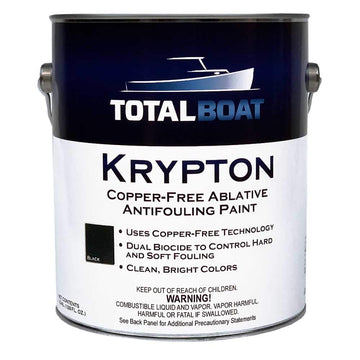

Krypton Copper-Free Boat Bottom Paint


1 comment
We had an Airstream travel trailer for several years. One summer I got ambitious and polished it. Used a metal polishing compound for aluminum hand applied then baking flour on the rag to take off the polishing compound. worked great and the trailer looked great for one season decided it took too long to do and never did it again. Now have a Marionette cabin cruiser all Aluminum hull. It’s painted so no polishing, and the bottom took me every weekend for a whole summer to grind the paint off then re-sanding before applying an etching primer. Then the barrier coat, then the abative antifouling paint al for aluminum boats. a lot of work and MONEY.