











Worth Gretter has been around boats long enough to know the difference between a project and a lost cause. This dinghy was definitely the former.
A Life on the Water
Worth Gretter’s relationship with boats goes back to the 1960s, when he and his brothers built a Folbot kayak from a kit. That project planted a seed, and by the 1970s, he and his then-wife were living aboard a fishing boat in a harbor in Crete, Greece. Not just living, but actively converting it, building a cabin, bunks, and a galley by hand.


Ruth’s Boat
The dinghy in question belongs to Ruth Pelham. It had been in her family since at least 1970 — her brother-in-law remembers it at the family’s cottage on the lake when he married into the family around that time. Exactly where the boat originally came from is lost to time, but it had clearly been through some hard years before Worth and Ruth got their hands on it.
The boat carries no HIN (hull identification number), which puts its manufacture sometime before the 1980s, when those numbers became standard. It was made by Puffin, a company still in business today. The fiberglass hull, Worth noted early on, was solid, making the boat was worth saving.
What wasn’t solid was almost everything else.

The Three Reasons Old Boats Have Problems
Worth has a saying he shares with people who ask about old boats: there are three reasons they have problems.
Rot from improper storage.
Impact damage to the hull.
Poor quality earlier repairs.
This dinghy had the third in abundance. Multiple layers of paint had been applied over decades without ever sanding or scraping the peeling paint beneath. In some spots, resin or putty had been patched over impact damage on the hull without properly addressing what was underneath. The port gunwale ahead of the center seat was badly bent. And hidden inside the bow and stern seats, the fiberglassed wood was completely rotted.


The bow (left) and stern corner (right): multiple layers of paint applied over peeling paint, with resin and putty added on top instead of addressing what was beneath.
The Work Begins
After an aggressive cleanup, Worth and Ruth sanded, filled, and sanded again before painting the exterior. Then came the part Worth describes simply as “the fun”: steam-bending new oak gunwales using the plastic bag method.
Worth learned the technique at a demonstration put on by a chapter of the Wooden Canoe Heritage Association (WCHA), of which he’s a member. The method uses narrow plastic tubing (the kind businesses use to package small items) to enclose the wood and hold steam. The key advantage over a traditional steam box: unlimited working time. With a steam box, wood begins to stiffen again within a minute of being pulled out. The plastic bag method lets you take your time.
The wood itself came from the Northeast Woodworkers Association’s annual Tool and Lumber Auction in Albany, NY — rough oak Worth had purchased years earlier at a low price because it had old worm damage. He and Ruth had to sort through the pile carefully to select healthy pieces. The center seat is one solid piece of oak; the stern seat is two pieces and the bow seat four, all biscuit-joined.
Once milled to size, ripped, planed, and sanded, the oak was finished with three coats of TotalBoat Wood Sealer Varnish Primer, followed by three coats of Halcyon water-based gloss varnish. The outwales and double inwales were then clamped into position and secured with long bronze screws. New bronze oarlocks matched the original sockets, chemically treated to tone down their shine and give them the aged look that suited the rest of the boat.
The biggest technical challenge was getting the inwales to fit cleanly at the bow. “Even though we cut them carefully, when we tightened the screws to pull the inwales tightly to the hull, we wound up with a little gap at the bow,” Worth says. They solved it with a small wedge.

On TotalBoat Products
Worth’s relationship with Jamestown Distributors goes back further than the canoe project — all the way to 1988, when he was building a house and ordered stainless steel ring nails for cedar siding because no one sold them locally. His carpenters thought it was a strange call. By the end of the job, they were converts.
The Wood Sealer Varnish Primer came into his toolkit on the canoe project. “It was a lot faster than many coats of varnish to get a similar result,” he says. He’d also tried Halcyon on a smaller project before that, and run into trouble — working indoors in winter, in a warm room with low humidity, he couldn’t keep a wet edge. He called TotalBoat customer service and was told he could thin it. He did, and it worked well. Both products made the shortlist for the dinghy.
For the dinghy, the system was the same as the canoe: three coats of the varnish primer, three coats of Halcyon gloss. The gunwales went on looking sharp and held up through installation.
Signed and Sealed
Before installing the center seat, Worth and Ruth did something that felt right: they signed the underside. “Restored Oct. ’25 to June ’26 — Ruth Pelham & Worth Gretter.” Hearts and peace signs filled in the rest of the space.
Eight months of work, made permanent in the wood.
“For me, it was the challenge of a new project,” Worth says. “For Ruth, it was bringing her beloved rowboat from a shabby past into a bright future. For both of us, it was the pleasure of collaboration, with a very rewarding outcome.”

Ready to Row
The dinghy is now on a cart in the garage, ready to roll out the door. Ruth is in touch with canvas companies about a cover, and the boat is headed to Copake Lake in eastern New York, near the Massachusetts border. Plans include a simple roller ramp so she can haul it up the beach on her own.
Worth’s advice for anyone thinking about a similar project: “There is lots of good info online — such as the WCHA discussion forums. Careful planning and consideration of the alternatives, before jumping in, always gets better results.”
And if the fiberglass is solid? The boat is worth saving!
Thank you Worth for sharing your story with us.

Have a boat project of your own? Our tech support team is happy to help you choose the right products. Email us info@totalboat.com.
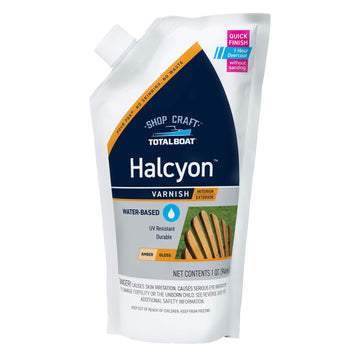
Halcyon Water-Based Marine Varnish


5 comments
Nice project and an even nicer story. Sometimes the journey is better than the destination. I am also trying out the new to me, Halcyon water base varnish. I just used it on the spars of two Cape Cod Frosty sailboats. I also used it on an old coffee table that I recently refinished. The table looks like a million dollars!
Wowzer guys! You both have always had attention to detail. Great work!
I did a similar project a couple Years ago! Similar dinghy, similar needs! The biggest challenge was gunnels with bend and twist! Halcyon finish .
I was so impressed.
Thanks for sharing.
Beautiful boat. Yrs ago built a mahogany sail dinghy.. Great project using Total boat poxy..