











Herb and Maddie Benavent, the adventurous duo behind the popular YouTube channel Rigging Doctor, have been living the cruising life since 2017. After putting serious nautical miles under their keel, they are taking everything they’ve learned and pouring it into their new project boat, Windpuff. Windpuff is a classic 1966 Alberg 30 that the couple is meticulously redesigning to be the ultimate short-handed ocean cruising sailboat.
Here at TotalBoat, we are thrilled to be a helping hand for all of Windpuff's fiberglass needs, outfitting the Rigging Doctor crew with the CSM, 1708 fiberglass, gelcoat, and polyester resin required to make this dream a reality.
In one of their recent episodes, "[How to] Seal Windows in a Project Boat | Windpuff's Rebuild," Herb tackles a critical upgrade for offshore safety: deleting the boat's classic, oversized windows. Originally fitted with a weak quarter-inch of plexiglass, these massive windows are a significant liability out on the open ocean, where a rogue wave could easily punch them out and leave a gaping hole.
Herb’s solution is to seal the large openings completely with fiberglass and replace them with smaller, ocean-rated bronze portlights featuring 3/8-inch thick tempered glass.
The Process: Building the Fiberglass Plug
To create a solid fiberglass plug for the windows, Herb used a simple but effective technique. He wedged a piece of inexpensive Formica board against the outside of the hull to act as a temporary mold. Working from the inside of the cabin, he glassed directly up against this template, tabbing the fiberglass onto the inside of the frame to form the inner half of the window plug.

Why Polyester Resin?
The Golden Rule of Bonding
During the video, Herb shares a crucial piece of boat-building wisdom regarding resin compatibility: epoxy will bond to polyester, but polyester does not bond well to epoxy.
Because Windpuff's entire exterior will be finished in polyester resin while the custom interior will utilize epoxy, Herb had to build these critical window plugs entirely out of polyester. These plugs act as the bridge between the interior and the exterior. If he had built the plugs with epoxy and later ground down the outside of the hull to fair the surface, he would expose that epoxy. This would ruin the bond for any subsequent exterior polyester layers.
Furthermore, Herb points out that polyester resin provides much more flexibility and working time for large-scale construction compared to epoxy, making it ideal for a massive hull rebuild. It is also significantly more budget-friendly, costing around $67 per gallon compared to epoxy's $100 per gallon.

Highlighting TotalBoat Polyester Resins
To execute this flawless structural repair, Herb relied on two specific TotalBoat products to get the chemistry exactly right:
-
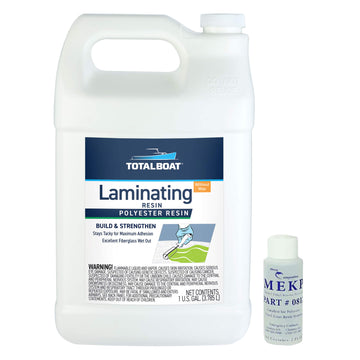
TotalBoat Polyester Laminating Resin: Herb used this for the bulk of the structural buildup. Laminating resin is designed to stay a little tacky and never fully cures on its own, meaning the fiberglass is always "waiting for the next layer". This is perfect for heavy layups because you can add more layers without having to stop, prep, and sand between coats.
-
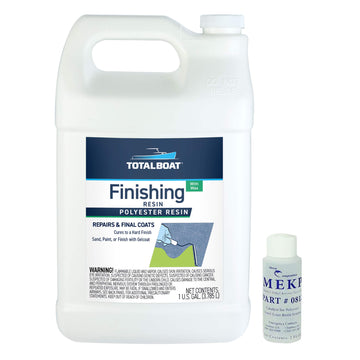
TotalBoat Polyester Finishing Resin: Once the interior structural layup was complete, Herb capped it off by painting on a layer of our finishing resin. Unlike laminating resin, finishing resin contains a wax additive. As it cures, the wax rises to the surface to seal out oxygen, allowing the polyester to fully cure to a hard, tack-free finish.

Looking Ahead
With the inner half of the window plugs fully cured and sealed, Herb has secured a solid polyester foundation. Now, he can safely move on to the epoxy work required for Windpuff's interior bulkheads, knowing that the outside hull can be safely ground and finished in polyester later on.
We are incredibly proud to support Herb, Maddie, and their macaws on this ambitious rebuild. Be sure to subscribe to the Rigging Doctor YouTube channel to follow Windpuff's transformation, and check out TotalBoat’s line of polyester resins for your own marine construction and repair projects!





10 comments
I’ve seen plenty of professionally built boats with extremely poor layups of glass. Both polyester and epoxy. Refitting an older A30 is a GREAT project. Has anyone attempted a similar project on a Tartan 10?
Obviously an amateur. And someone who should NOT be giving advice. I could go on and on… But really, I will just let it go. Viewer BEWARE! Bad technique and bad ideas abound.
First rule when filling a hole in a fiberglass vessel (especially a structural one) is to taper the edges (12:1 as an example). I didn’t see that in the video; if not, I believe you are creating a potentially more dangerous situation than you are trying to solve.
Destroying the charm of the A30. I couldn’t bring myself to watch anymore.
Destroying the charm of the A30. I couldn’t bring myself to watch anymore.