











How Gleam Was Born: The TotalBoat Story of Listening, Simplifying, and Never Settling
March 2026
Behind every great product is a problem worth solving — and a team willing to get their hands dirty to solve it.
There's a particular kind of dissatisfaction that drives good product development. Not the frustrated kind that gives up, but the restless kind that keeps showing up at boatyards, picking up a brush, watching, and asking questions. That's where Gleam Marine Varnish began — not in a lab, not in a boardroom, but dockside.
For TotalBoat CEO Mike Mills, the origin of Gleam is inseparable from a simple observation: customers loved what Pettit Captain's Varnish delivered. The gloss. The color. The usability. But they kept running into the same wall.
"We learned that customers wanted it to cure faster," Mike explains. "That was the improvement we were aiming for."
It sounds deceptively simple. But in marine coatings, faster is one of the hardest words in the dictionary.

The Real Problem: Days, Not Hours
To understand why the 1-hour overcoat matters, you have to understand what varnishing used to look like.
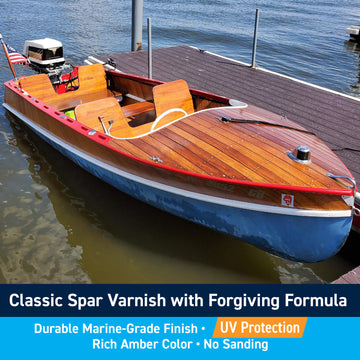
The top-selling varnishes on the market like Pettit Captain's, Epifanes Clear Varnish, cured overnight. That meant a proper brightwork job stretched into a multi-day commitment: sand, coat, wait, sand, coat, wait. Three, four, sometimes five days. For a professional boatyard working between weather windows and daylight hours, that's an enormous amount of dead time. For a weekend DIYer who just wants their boat back on the water, it can feel like the finish will never come.
Eric Boudreau, TotalBoat's in-house product specialist, captured the problem with precision:
"Applying 6, 8, 10, or more coats of varnish to a boat takes a long time to do. Too long. When applying varnish outdoors, you're working between weather windows, windy days, and daylight hours. We wanted to cut that time down."
But cutting time wasn't just about convenience. Longer cure windows meant longer exposure to airborne dust — the silent enemy of a flawless finish. Every hour the wet film sat open was another hour for particles to settle into what should be glass-smooth wood. Solving the time problem meant solving the quality problem, too.
Going to the Source
TotalBoat didn't design Gleam from behind a desk. The team went out — to boatyards, to customers, to the boats themselves.
"It was a combo of varnishing ourselves, visiting boatyards, talking to customers via phone and emails," Mike says. "We visited a bunch of JD varnish customers and learned their processes."
This isn't a minor detail. It's the difference between a product that sounds good on paper and one that actually works in someone's hands, on a Tuesday morning, with humidity climbing and the wind picking up. The feedback TotalBoat gathered wasn't theoretical. It came from people who varnished for a living, who could articulate exactly where every existing product fell short.
The ask that kept surfacing: give us something glossy, ready-to-use, and fast — but don't sacrifice the finish.
From that listening came a clear set of non-negotiables. The product had to be ready out of the can, with no thinning required for most applications. It had to allow for what professionals call "hot-coating" — overcoating without sanding between every single layer. And it had to do all of this while still delivering the depth, clarity, and UV resistance that define a top-tier marine spar varnish.

The Chemistry of Fast
Making a varnish dry fast is easy. Making a varnish dry fast and maintain every quality characteristic of a traditional oil-based finish is another matter entirely. Eric explains the tightrope the R&D team had to walk:
"In order to make the varnish become tack-free quickly, there is a very, very fine balance of solvents, dryers, and other additives. The fine balance of these components would allow for good flow and ample wet edge time, then becoming tack-free quickly — but still being open to accept more coats without sanding."
That balance doesn't exist in isolation. It has to hold across the full range of conditions a New England varnisher actually encounters: warm summer days, cool spring mornings, and everything in between. The same formula that performs at 80°F needs to behave at 50°F. Getting that right consistently, across a production run required constant iteration between the TotalBoat team and their manufacturing partner.
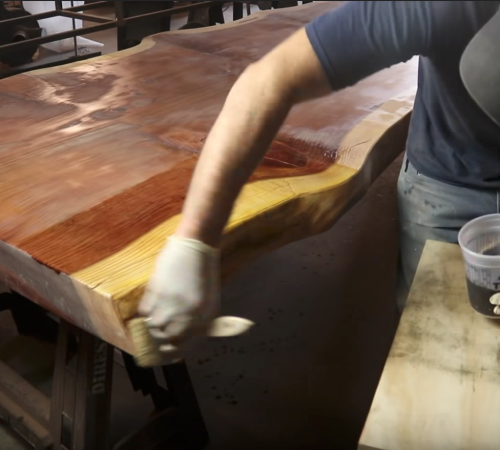
Drawdowns were performed with each sample to check for the right clarity and color, a glassy high-gloss finish, and the required dry times. Application tests were performed on flat surfaces and dimensional wood pieces to check for dripping and sagging. Eric tested samples on his own boat. The team ran shop nights at TotalBoat where local varnish professionals tried the product firsthand and gave unfiltered feedback. Samples went out to influencers and trusted customers. Every round of testing generated refinements. Every refinement brought us closer to the product we now know as Gleam.
"We listened to customers," Mike says, "we worked with our suppliers, we did a lot of varnishing, we shared samples with our influencers and customers, we got feedback, we went back to the suppliers and tweaked the formula, and continued down the path. Continuous improvement."
The spirit of that phrase — continuous improvement — is worth sitting with. It's not the language of a one-and-done product launch. It's the mindset of a team that treats a formula not as a destination but as a conversation that never fully ends.

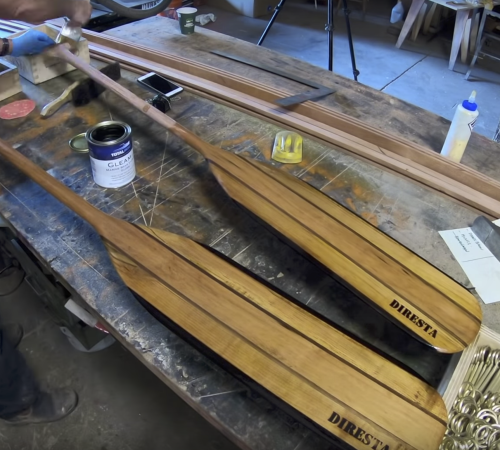
TotalBoat Ambassador Jimmy Diresta using Gleam Marine Spar Varnish in his 47' Cadillac to Woody Extreme Make Over.
Making It Simple Enough to Own
Great performance means nothing if the product is intimidating to use. That's where Cheryl, TotalBoat's creative lead, entered the picture — and where the internal work of product development met the outward challenge of communicating it.
"I quickly learned that varnishers are loyal to the brands they know and trust," she says. "That meant our packaging had to earn attention fast — clearly and confidently communicating Gleam's point of difference in just a few seconds."
That difference, she and Eric both confirmed, was real and rare: no other varnish on the market offered a one-hour recoat without sanding. The message had to land instantly, and it had to feel earned rather than gimmicky.
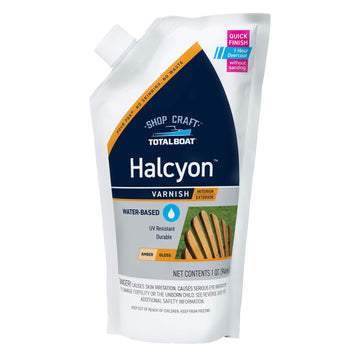
Cheryl's solution was elegantly layered. A magenta callout flag pops on the shelf. A skewed cyan shape set at the same angle as the lobster boat's bow in TotalBoat's logo creates a subtle sense of motion, reinforcing the feeling of speed without saying a word. The navy-and-white packaging immediately reads as authentic marine heritage. A cyan boot stripe completes the nautical palette and doubles as a visual system, helping customers navigate the product line at a glance.
But underneath the visual strategy was a single, non-negotiable message: no thinning required.
"We wanted Gleam to own the simple joy of opening the can and getting right to work — no extra steps, no guesswork," Cheryl explains.
That principle — reducing friction between a customer and a great result — runs through everything about how Gleam was built. Not just designed onto the label, but engineered into the formula. The viscosity was calibrated precisely so that the product wouldn't sag or drip on vertical surfaces right out of the can, giving varnishers one less variable to manage before the brush even hits the wood.
One of Cheryl's favorite moments from the project tells you something about the culture behind the product. Kristin Browne, TotalBoat's Director of Brand PR, and her husband invited the creative team out on the water to photograph the Gleam-finished brightwork on their own Hinckley for the packaging hero shot. The product wasn't a prop. It was on someone's actual boat, finishing wood that someone actually cared about.

What Gleam Actually Does for You
For anyone picking up a brush for the first time, or returning to a brightwork project after years away, the practical upshot of all this development work is meaningful.
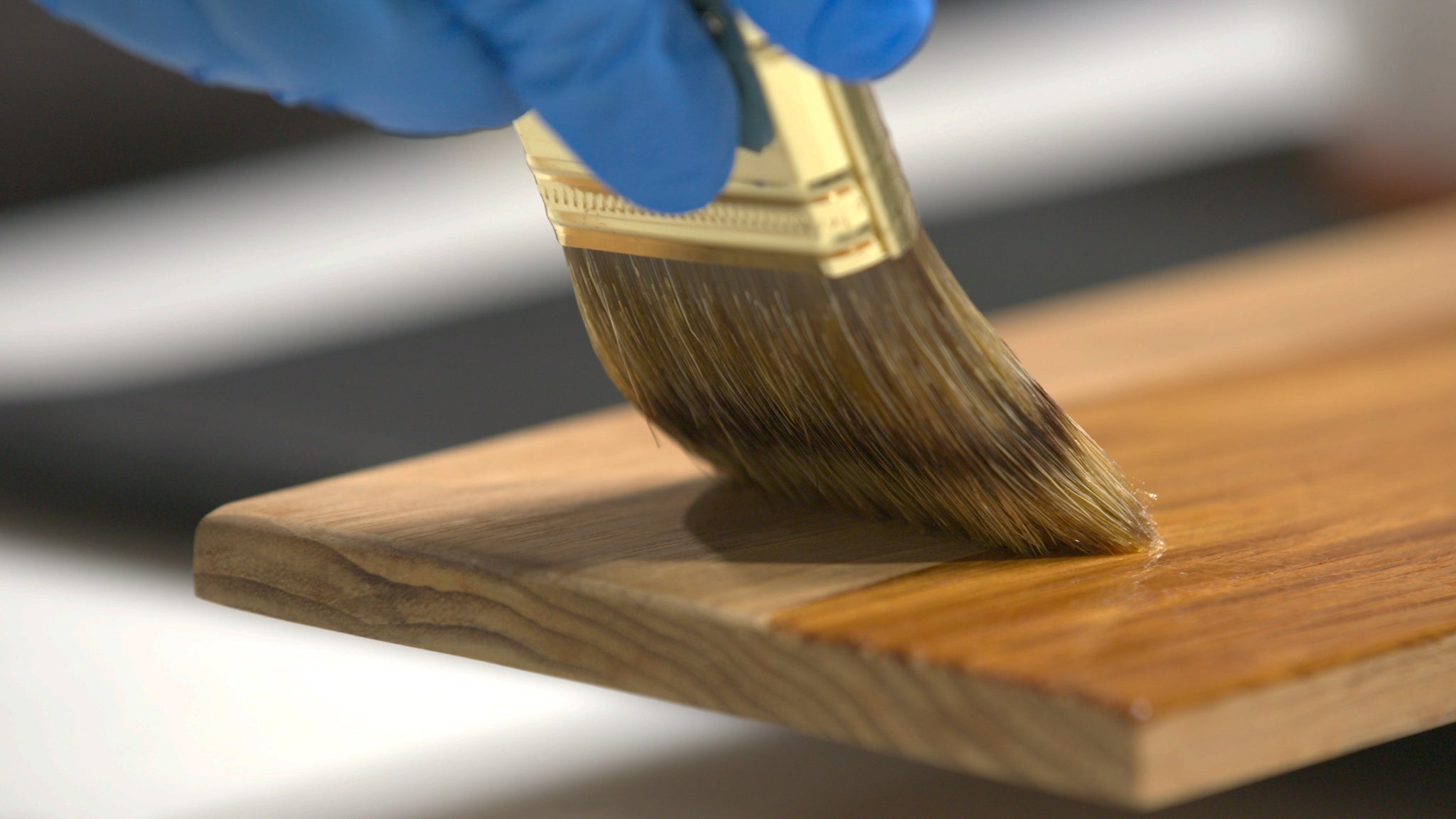
Gleam allows you to apply two to three coats in a single day, depending on temperature. At 80°F, you can recoat in as little as one hour. At 65°F, three hours. Even at 50°F — conditions that would have meant an overnight wait with most traditional varnishes — you're back to work within eight hours.
The result is a varnish job that used to take four or five days now taking one or two. As Mike puts it: "Varnishing is fun, but maybe not five days of fun."
Eric's expert tips for getting the most out of Gleam reinforce the same ethos that built it — preparation, patience where it counts, and not overcomplicating what doesn't need to be complicated:
Don't apply too thick. More coats of a thinner film will always outperform fewer thick ones. Thick application slows drying dramatically and can trap solvents beneath the skin of the film — tack-free to the touch, but soft underneath.
- Surface preparation is everything. Sanding marks and an uneven substrate will telegraph through even the best finish. Take the extra time before the first coat.
- Build coats thoughtfully. Gleam likes two to three coats per day, but before a final sanding and topcoat, giving the film four to five days to fully tighten up will yield a smoother, more uniform result than rushing it.
- Don't apply too thick. More coats of a thinner film will always outperform fewer thick ones. Thick application slows drying dramatically and can trap solvents beneath the skin of the film — tack-free to the touch, but soft underneath.
The Values Behind the Varnish
What makes the Gleam story worth telling isn't just that TotalBoat made a better varnish. It's how we made it, and why the process reflects something durable about how we operate.
Listen to the Customer isn't a tagline at TotalBoat. It's the reason Mike and the team drove to boatyards instead of running a survey. It's why samples went to real professionals before anything went to production. It's the reason the feedback loop between customer, team, and supplier kept spinning even after the product was market-ready.
Make it Simple shows up in a formula engineered to be ready out of the can, in packaging designed to eliminate confusion at the shelf, and in a recoat window that turns a multi-day obligation into a single Saturday.
Always Continue to Improve is what keeps the formula from ever being finished. It's what sends Eric back to the drawdown tests and the sample boards even when the product is already good. It's the refusal to treat "good enough" as a destination.
Gleam Marine Varnish is the result of all three operating together — not as values on a wall, but as verbs. We listened. We simplified. And we kept going.
The wood's been waiting long enough. Explore Gleam Marine Spar Varnish →

Do It Yourself But Not on Your Own
Comments
I haven’t tried Gleam and to speed up drying time, was Japan Dryer added to the varnish. I worked with high gloss polyurethane ( Minwax Heldsman Spar Urethane ) thinned with naphtha for an interior varnish finish. In the future I will try some Gleam.