









Dave Ahrens is building Theresa II, a 1913 canoe counter-stern yawl whose only original hull was lost years ago. More than a century after Albert Strange drew her lines, she's taking shape again in a Northern California shop.

A Design That Drifted Out of History
Theresa II is design #139, drawn by the English yacht designer and painter Albert Strange in 1913. She's a gaff-rigged, canoe counter-stern yawl measuring 25.5 feet on deck, with a 7'6" beam, a 3'7" draft, and a displacement of 8,300 pounds, 3,300 of which is lead in the keel. Only one was ever built. She sailed around Scotland and the UK for many years before, as Dave puts it, she "drifted down the dark well of history."
A few years ago, that original boat was found in an unlikely way. Someone browsing historical imagery in Google Earth spotted her in a boatyard on the Isle of Man in 2009, sitting high and dry and alone. It turned out she was burned not long after that image was taken.

The Albert Strange Association works to promote Strange's designs and artwork, and it has helped save a number of his boats over the years, including the well-known Tally Ho. Theresa II didn't get that second chance. Dave is giving her a new one by building her again from the original design, and when she's finished, she'll be the only one of her kind on the water.
"For me, this is more than a hobby, more than a mission," Dave says. "It's a life goal to build something inspirational and beautiful. There is magic in her lines that seems transformational to all who see her."

How a Boat Came to Mean Freedom
Dave didn't grow up in a family of boatbuilders. "I can't recall anyone in my family ever building much of anything," he says. "But we did always have a boat, and a boat to me meant freedom." That early time on the water turned into a lifelong interest in maritime history and in the traditional wooden boats and ships he watched slowly disappearing.

Since then, he has built four boats, a lot of fine furniture, and rebuilt several houses. Now retired, he built his own home and a 3,500-square-foot shop in Northern California, and that's where Theresa II is taking shape. His previous boat, built from red cedar and High Performance Epoxy, was recently featured in WoodenBoat magazine.

When he first came across Theresa II's drawings, he knew right away. On his website, he writes that the design leapt off the page, and he could picture the sparkle of the sea and the steep cliffs along the Scottish coast.
Building Her Strong with a Double Planking Method
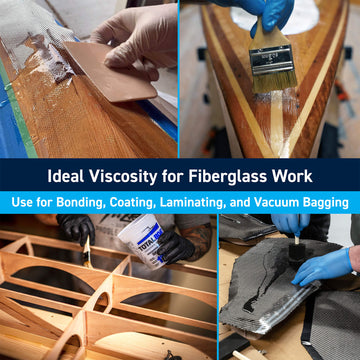
Theresa II's construction mixes traditional materials with modern epoxy techniques. All of the major centerline parts, including the stem, keel timber, stern post, knee, and horn timber, are laminated from Douglas fir using High Performance Epoxy. Her 38 frames per side are laminated white oak, glued up with Thixo and Flexepox.


For the planking, Dave uses Alaskan yellow cedar in a double planking method. There are two layers of horizontal planking with overlapping seams: a 1/2" inner layer and a 1/4" outer layer. The process works like this:
-
The inner plank is glued to the frames with thickened High Performance Epoxy, and then two bronze boat nails are driven into each frame.
-
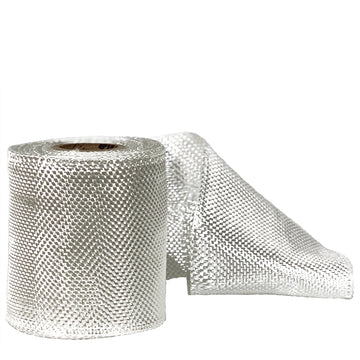
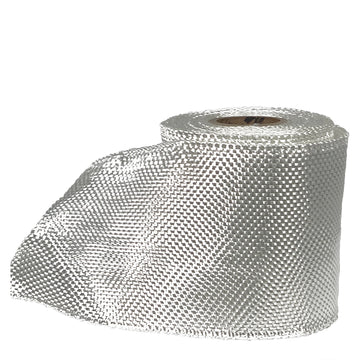
The seam is taped with 4 oz fiberglass tape and filled with epoxy.
-
The outer 1/4" plank is glued over the top with thickened epoxy so it covers the seam below, and held in place with clamps and plastic staples while it cures.

"Double planking is a close cousin to cold molding but is a bit faster and incredibly strong," Dave says. He's quick to point out that he didn't invent double planking, but he's never seen anyone do it quite the way he does. In all his boatbuilding books, he's only come across a few short paragraphs on the technique, and those were written long before epoxy and plastic staples came along.

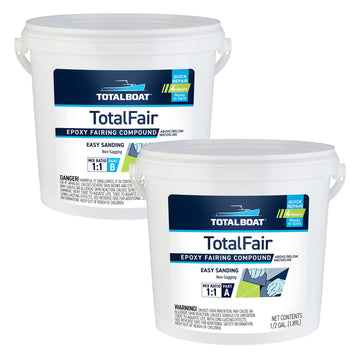
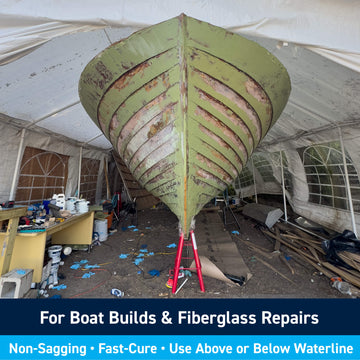
The hull is nearly complete now. Once the planking is finished, Dave will fair the entire hull using gallons of TotalBoat TotalFair, then sheathe it with two layers of cloth, or possibly 1708 biaxial, saturated with High Performance Epoxy.

Why He Trusts TotalBoat
Dave has been buying from Jamestown Distributors since the mid-1980s, and he thinks he first found the name in WoodenBoat magazine. He's used High Performance Epoxy, along with a variety of TotalBoat fillers, on several boats over the years, and Theresa II is getting a lot of it, mostly mixed with slow hardener.
"I have heard it said that epoxy is epoxy, it is all the same. I disagree," he says. "I have used other brands and they are not as easy to work with. As long as I follow the rules regarding time and temperature, I can count on a consistent result."
He values the support behind the product just as much. "If I have a problem or question, I don't want to speak with someone overseas. I want to speak with someone who knows the product and is deeply embedded in the industry," Dave says. "Thank you, Jamestown, for being there with your helpline. You've saved me more than once."

A Boat That Draws a Crowd
To Dave, the best part of the project is the attention Theresa II draws. "I have always thought that aesthetics inspire creativity, not the other way around," he says. "Few things are more aesthetic than a classic, gaff-rigged yawl."
A steady stream of admirers and volunteers stops by the shop to watch or help out, and some of them travel hundreds of miles to do it. "When someone new walks in my shop and sees Theresa for the first time, there is always a reaction," he says. He's always happy to teach, and he's thinking about offering small tutoring sessions or classes, or teaming up with someone online to reach more people.
He thinks part of the appeal is the designer, part is his unusual building method, and part is simply that she's a one-of-a-kind yawl from more than a century ago. "Yawls just breathe history and romance," he says, "and those things which now seem almost lost."
That's exactly why he writes about the build. "My sole purpose for this is to promote interest in boatbuilding, hopefully in young people," he says.

Follow the Build
Dave documents the Theresa II build on his website, Northshore Boats, where you can also read "First Ocean," his story about how he first fell in love with sailing. He writes a monthly update for the Albert Strange Association newsletter as well, which is a good place to learn more about Strange's designs, artwork, and the boats the Association has helped save.
Questions About Your Own Build?
Whether you're laminating frames, fairing a hull, or planning a project of your own, the TotalBoat tech support team is here to help you choose the right epoxy, filler, and approach. Call us at 888-986-6623 or reach out online, and talk to people who know the products and use them in their own shops.

Clear High Performance Epoxy Kits


FlexEpox Flexible Epoxy Adhesive


Thixo 2:1 Epoxy Adhesive System
TotalFair Epoxy Fairing Compound


2 comments
Those laminated frames, stems, and other parts are going to be twice as strong as the original parts were!
Great photos and story. Thanks for sharing!